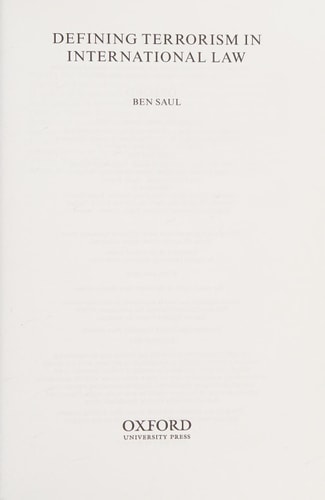
Defining Terrorism in International Law
0
0
As an Amazon Associate and affiliate partner, Menrva Books earns from qualifying purchases. Learn more
Author Description
Despite numerous efforts since the 1920s, the international community has failed to define or criminalize 'terrorism' in international law. This book first explores the policy reasons for defining and criminalizing terrorism, before proposing the basic elements of an international definition. Terrorism should be defined and criminalized because it seriously undermines fundamental human rights, jeopardizes the State and peaceful politics, and may threaten international peace and security. Definition would also help to distinguish political from private violence, eliminating the overreach of the many 'sectoral' anti-terrorism treaties. A definition may also help to confine the scope of UN Security Council resolutions since 11 September 2001, which have encouraged States to pursue unilateral and excessive counter-terrorism measures.Defining terrorism as a discrete international crime normatively recognizes and protects vital international community values and interests, symbolically expresses community condemnation, and stigmatizes offenders. Any definition of terrorism must also accommodate reasonable claims to political violence, particularly against repressive governments, and this book examines the range of exceptions, justifications, excuses, defenses and amnesties potentially available to terrorists, as well as purported exceptions such as self-determination struggles, 'State terrorism' and armed conflicts.While this book seeks to minimize recourse to violence, it recognizes that international law should not become complicit in oppression by criminalizing legitimate forms of political resistance. In the absence of an international definition, the remainder of the book explores how the international community has responded to terrorism in international and 'regional' treaties, the United Nations system, and in customary law. The final part of the book explores the distinctive prohibitions and crime of 'terrorism' in armed conflict under international humanitarian law.
Menrva's Summary
THE THESIS
This book investigates the persistent failure of the international community to establish a universally accepted legal definition of terrorism and proposes a framework to address this normative gap. Ben Saul, a scholar of international law, synthesizes decades of treaty history, UN Security Council resolutions, and customary law to argue that a precise definition is necessary to protect human rights and prevent the overreach of counter-terrorism measures. The text evaluates the tension between criminalizing violence and preserving the legitimacy of political resistance, particularly in contexts of state oppression or self-determination struggles.
THE SCOPE MAP
What You Will Find
- A comprehensive analysis of international and regional anti-terrorism treaties from the 1920s to the present.
- A proposed normative framework for defining terrorism as a discrete international crime.
- Examination of legal defenses, justifications, and exceptions including state terrorism and armed conflict.
- Evaluation of the impact of post-9/11 UN Security Council resolutions on state counter-terrorism practices.
THE AUTHORITY PERSPECTIVE
Legal scholars and practitioners frequently cite this work as a foundational text for understanding the complexities of international criminal law regarding political violence. Readers often note the high density of the prose and the rigorous academic approach to reconciling conflicting state interests in international legal forums.
Page Count:
416
Publication Date:
2008-04-15
Publisher:
Oxford University Press
ISBN-10:
0199535477
ISBN-13:
9780199535477
Human rights
International Law
Law
Community Tags
Other Editions(2)
Similar Books







Reader Comments
Share Your Thoughts
No comments yet. Be the first to share your thoughts!