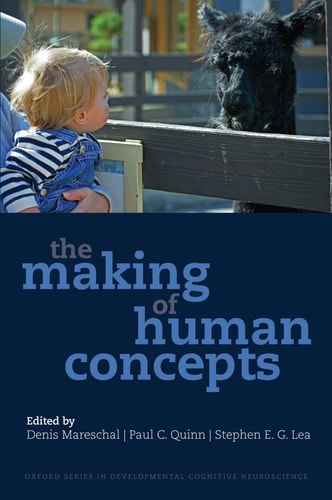
The Making of Human Concepts: Developmental Cognitive Neuroscience
0
0
As an Amazon Associate and affiliate partner, Menrva Books earns from qualifying purchases. Learn more
Author Description
Human adults appear different from other animals in their ability to form abstract mental representations that go beyond perceptual similarity. In short, they can conceptualize the world. This apparent uniqueness leads to an immediate puzzle: WHEN and HOW does this abstract system come into being? To answer this question we need to explore the origins of adult concepts, both developmentally and phylogenetically; When does the developing child acquire the ability to use abstract concepts?; does the transition occur around 2 years, with the onset of symbolic representation and language? Or, is it independent of the emergence of language?; when in evolutionary history did an abstract representational system emerge?; is there something unique about the human brain? How would a computational system operating on the basis of perceptual associations develop into a system operating on the basis of abstract relations?; is this ability present in other species, but masked by their inability to verbalise abstractions? Perhaps the very notion of concepts is empty and should be done away with altogether.This book tackles the age-old puzzle of what might be unique about human concepts. Intuitively, we have a sense that our thoughts are somehow different from those of animals and young children such as infants. Yet, if true, this raises the question of where and how this uniqueness arises. What are the factors that have played out during the life course of the individual and over the evolution of humans that have contributed to the emergence of this apparently unique ability? This volume brings together a collection of world specialists who have grappled with these questions from different perspectives to try to resolve the issue. It includes contributions from leading psychologists, neuroscientists, child and infant specialists, and animal cognition specialists. Taken together, this story leads to the idea that there is no unique ingredient in the emergence of human concepts, but rather a powerful and potentially unique mix of biological abilities and personal and social history that has led to where the human mind now stands.A 'must-read' for students and researchers in the cognitive sciences.
Menrva's Summary
THE THESIS
This volume investigates the origins and development of abstract mental representations to determine whether human conceptualization is a unique cognitive achievement or a product of shared evolutionary and developmental processes. The authors, including Denis Mareschal, Paul C. Quinn, and Stephen E. G. Lea, curate a multidisciplinary collection of research from psychologists, neuroscientists, and animal cognition experts. By synthesizing data from infant development and comparative biology, the text challenges the assumption that human conceptual ability is fundamentally distinct from other species. The contributors evaluate whether abstract thought emerges from language acquisition or if it exists independently as a computational evolution of perceptual association systems.
THE SCOPE MAP
What You Will Find
- Comparative analysis of cognitive development in human infants versus non-human species.
- Examination of the transition from perceptual-based associations to abstract relational thinking.
- Integration of neuroscientific data and evolutionary history to map the emergence of symbolic representation.
- Critical evaluation of the necessity and validity of the concept of 'concepts' in cognitive science.
THE AUTHORITY PERSPECTIVE
Experts recognize this volume as a comprehensive synthesis of current debates in cognitive development and comparative psychology. Readers frequently note the academic density of the prose, which serves as a rigorous resource for researchers and students interested in the intersection of biology and cognition.
Page Count:
416
Publication Date:
2010-04-10
Publisher:
Oxford University Press
ISBN-10:
0199549222
ISBN-13:
9780199549221
Psychology
Developmental Psychology
Neuroscience
Thought And Thinking
Concepts
Cognition
Evolutionary Biology
Community Tags
Similar Books








Reader Comments
Share Your Thoughts
No comments yet. Be the first to share your thoughts!