Primate Neuroethology
0
0
As an Amazon Associate and affiliate partner, Menrva Books earns from qualifying purchases. Learn more
Author Description
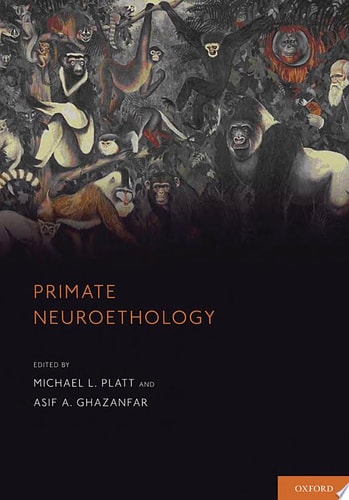
Why do people find monkeys and apes so compelling to watch? One clear answer is that they seem so similar to us-a window into our own minds and how we have evolved over millennia. As Charles Darwin wrote in his Notebook M, "He who understands baboon would do more toward metaphysics than Locke." Darwin recognized that behavior and cognition, and the neural architecture that support them, evolved to solve specific social and ecological problems. Defining these problems for neurobiological study, and conveying neurobiological results to ethologists and psychologists, is fundamental to an evolutionary understanding of brain and behavior.The 'neuroethological' approach envisioned by Darwin, pioneered by the European ethologists, and refined by modern neurobiologists and biologists, has provided rich insights into the minds of several nonhuman animals such as bats, electric fish, and songbirds. In stark contrast, studies of the function and structure of primate brains too often focus on more general cognitive processes and neural measures (e.g., brain size), while neglecting species-typical behaviors. A more promising, and biologically plausible, approach to understanding our place in nature would be to move beyond such coarse approaches and investigate the anatomy and physiology of particular brain systems as they relate to species-typical behaviors. That is, we must develop a neuroethology of primate behavior and cognition.The goal of this book is to do just that. It collects, for the first time in a single book, information on primate behavior and cognition, neurobiology, and the emerging discipline of neuroethology. Here leading scientists in several fields review work ranging from primate foraging behavior to the neurophysiology of motor control, from vocal communication to the functions of the auditory cortex. The resulting synthesis of cognitive, ethological and neurobiological approaches to primate behavior yields a richer understanding of our primate cousins that
Menrva's Summary
THE THESIS
This book investigates how the integration of neurobiology and ethology can provide a more accurate understanding of primate brain function and evolutionary development. The authors, Asif A. Ghazanfar and Michael J. Platt, curate a collection of expert contributions that bridge the gap between cognitive psychology and neural architecture. By focusing on species-typical behaviors rather than generalized cognitive measures, the text argues for a shift toward a neuroethological framework that treats primate behavior as a direct response to specific ecological and social pressures.
THE SCOPE MAP
What You Will Find
- Analysis of primate foraging behaviors and their corresponding neural mechanisms.
- Examination of motor control neurophysiology and auditory cortex functions.
- Synthesis of vocal communication research within an evolutionary context.
- Methodological approaches for linking anatomical brain structures to specific social behaviors.
THE AUTHORITY PERSPECTIVE
Experts identify this volume as a critical reference for researchers seeking to unify disparate fields of primate study. Readers frequently note the academic density of the prose, which serves as a foundational text for advanced students and professionals in the behavioral sciences.
Page Count:
688
Publication Date:
2010-03-01
Publisher:
Oxford University Press
ISBN-10:
0195326598
ISBN-13:
9780195326598
Science
Psychology
Neurobiology
Primatology
Allied Health
Zoology
Psychology Comparative
Evolutionary Biology
Cognition
Biology
Physiology Comparative
Medical
Veterinary Medicine
Primates
Neuroscience
Community Tags
Other Editions(2)
Similar Books










Reader Comments
Share Your Thoughts
No comments yet. Be the first to share your thoughts!