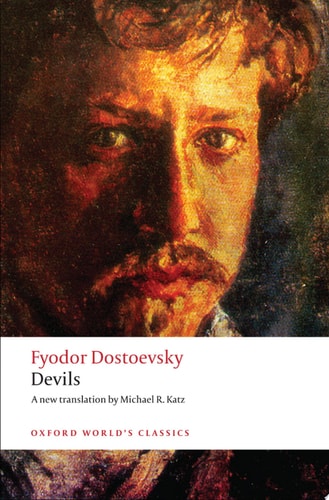
Devils
0
0
As an Amazon Associate and affiliate partner, Menrva Books earns from qualifying purchases. Learn more
Author Description
The third of Dostoevsky's five major novels, Devils (1871-2), also known as The Possessed, is at once a powerful political tract and a profound study of atheism, depicting the disarray that follows the appearance of a band of modish radicals in a small provincial town. This new translation includes the chapter "Stavrogin's confession," initially censored by Dostoevsky's publisher.About the Series: For over 100 years Oxford World's Classics has made available the broadest spectrum of literature from around the globe. Each affordable volume reflects Oxford's commitment to scholarship, providing the most accurate text plus a wealth of other valuable features, including expert introductions by leading authorities, voluminous notes to clarify the text, up-to-date bibliographies for further study, and much more.
Menrva's Summary
THE PULSE
A small provincial town descends into chaos and moral decay following the arrival of a group of radical nihilists who seek to dismantle the existing social order. The protagonist, Nikolai Stavrogin, serves as the enigmatic center around which various political agitators and disaffected intellectuals orbit, each vying for influence over the town's future. Dostoevsky employs a complex, multi-layered narrative framework that shifts between satirical observation and intense psychological examination of his characters' ideological motivations. The story is constrained by the rigid social hierarchies of 19th-century Russia and the inevitable, violent consequences of the radicals' destructive philosophy.
INSIDE THE PAGES
- Exploration of nihilism and its impact on social stability
- Satirical portrayal of provincial Russian bureaucracy
- Inclusion of the controversial chapter 'Stavrogin's Confession'
- Psychological depth regarding the nature of atheism and belief
- Multi-perspective narrative structure
- Examination of the influence of Western ideas on Russian culture
- Thematic focus on moral responsibility and individual agency
- Detailed character studies of radicalized youth
THE COLLECTIVE ECHO
Readers and critics frequently highlight the novel's intense focus on the intersection of political ideology and personal morality. Discussion often centers on the chilling accuracy with which Dostoevsky predicts the rise of extremist movements and the subsequent societal collapse. While some readers find the pacing deliberate and dense, others praise the effectiveness of the atmosphere in conveying a sense of impending doom. The balance between philosophical discourse and character-driven drama remains a primary point of analysis for scholars of Russian literature. Many note that the inclusion of the previously censored chapter provides essential context for understanding the protagonist's complex psychological state.
Page Count:
800
Publication Date:
2008-07-15
Publisher:
Oxford University Press
ISBN-10:
0199540497
ISBN-13:
9780199540495
Satire
Political fiction
Philosophical
Russian
classic
Community Tags
Similar Books