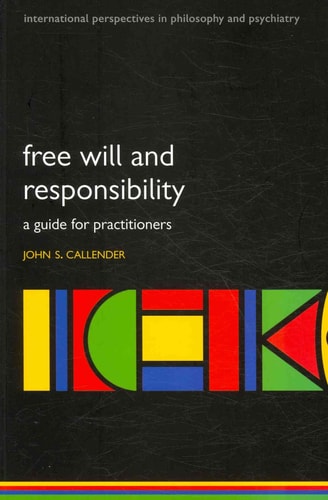
Free Will and Responsibility: A Guide for Practitioners
0
0
As an Amazon Associate and affiliate partner, Menrva Books earns from qualifying purchases. Learn more
Author Description
'We know our will is free and there's an end on't'. Dr. Johnson's words express a widely held intuition about free will, namely that our actions are the effects of our choices and decisions, and these choices and decisions are not the effects of antecedent causes. At least for some of our actions, the causal chain begins with conscious deliberation about what to do. It is this intuition that informs our attitudes to wrongdoing and justifies the belief that wrongdoers should be punished because this is what they deserve. However, we also know that we live in a world in which events have causes.Research in psychology, psychiatry and the neurosciences aims to investigate the causes of our thoughts, feelings and behaviour, and new techniques, such as neuroimaging, as well as developments in molecular genetics, are demonstrating the many ways in which dysfunction of the brain can lead to the kinds of behaviours that have hitherto been regarded as moral or immoral. So how can our intuitive sense of freedom be reconciled with causal determinism? How can moral judgment and punishment be compatible with the belief that the events that are human actions are, like any other event, the effects of prior causes?In Free Will and Responsibility, John Callender starts by describing the evolution of morality and the roles of reason and emotion in the making of moral judgments. He then summarises recent neuroscientific research on volitional behaviour, moral decision-making, and criminality, and discusses what this might mean for our practices of blame and punishment. In the second part, he examines the overlaps between art, free will, and moral value and argues that this offers a paradigm that reconciles our subjective sense of freedom with causal determinism. Finally, he examines these ideas in the clinical context of conditions such as psychopathic personality disorder, post-traumatic stress disorder and the dissociative disorders and discusses their implications for psychotherapy.This book makes a unique contribution to the philosophy and psychiatry literature, and will be fascinating reading for both practising psychiatrists, as well as philosophers, neuroscientists, and psychologists.
Menrva's Summary
THE THESIS
This book investigates the fundamental tension between the human intuition of free will and the scientific evidence for causal determinism within the context of moral responsibility. John S. Callender, a psychiatrist, utilizes a multidisciplinary framework to bridge the gap between neuroscientific findings and ethical practice. By synthesizing evolutionary biology, neuroscience, and clinical psychiatry, the author argues for a paradigm that reconciles subjective agency with the deterministic nature of human behavior.
THE SCOPE MAP
What You Will Find
- Analysis of the evolution of morality and the interplay between reason and emotion.
- Review of neuroscientific research concerning volitional behavior, moral decision-making, and criminality.
- Examination of the relationship between art, subjective freedom, and moral value.
- Clinical application of these theories to conditions such as psychopathic personality disorder, post-traumatic stress disorder, and dissociative disorders.
THE AUTHORITY PERSPECTIVE
Experts recognize this work as a significant contribution to the intersection of philosophy and clinical psychiatry. Readers frequently note the clarity with which the author navigates complex neuroscientific data to address practical questions of blame and punishment.
Page Count:
380
Publication Date:
2010-06-25
Publisher:
Oxford University Press
ISBN-10:
0199545553
ISBN-13:
9780199545551
Philosophy
Psychology
Psychiatry
Neuroscience
Decision Making
Responsibility
Ethics
Community Tags
Similar Books
Reader Comments
Share Your Thoughts
No comments yet. Be the first to share your thoughts!