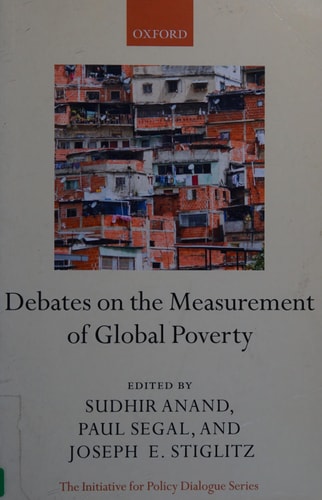
Debates on the Measurement of Global Poverty
0
0
As an Amazon Associate and affiliate partner, Menrva Books earns from qualifying purchases. Learn more
Author Description
The international community's commitment to halve global poverty by 2015 has been enshrined in the first Millennium Development Goal. How global poverty is measured is a critical element in assessing progress towards this goal, and different researchers have presented widely-varying estimates. The chapters in this volume address a range of problems in the measurement and estimation of global poverty, from a variety of viewpoints. Topics covered include the controversies surrounding the definition of a global poverty line; the use of purchasing power parity exchange rates to map the poverty line across countries; and the quality, and appropriate use, of data from national accounts and household surveys. Both official and independent estimates of global poverty have proved to be controversial, and this volume presents and analyses the lively debate that has ensued.
Menrva's Summary
THE THESIS
This volume investigates the methodological challenges and political implications inherent in defining and measuring global poverty levels. Edited by Nobel laureate Joseph E. Stiglitz alongside Paul Segal and Sudhir Anand, the text compiles diverse scholarly perspectives to evaluate how international organizations and researchers quantify economic deprivation. The authors analyze the technical discrepancies between official estimates and independent research, arguing that the choice of metrics directly influences the perceived success of global development initiatives.
THE SCOPE MAP
What You Will Find
- Analysis of the controversies surrounding the establishment of a universal global poverty line.
- Technical evaluation of purchasing power parity exchange rates in cross-country comparisons.
- Assessment of the reliability and integration of national accounts versus household survey data.
- Examination of the political and policy-driven debates regarding the Millennium Development Goals.
THE AUTHORITY PERSPECTIVE
Experts recognize this collection as a vital resource for understanding the complexities of development economics and statistical policy. Readers frequently note the technical density of the prose, which serves as a foundational text for students and practitioners in international development.
Page Count:
304
Publication Date:
2010-04-30
Publisher:
Oxford University Press
ISBN-10:
0199558043
ISBN-13:
9780199558049
Economics
Development
Statistics
Poverty
Public Policy