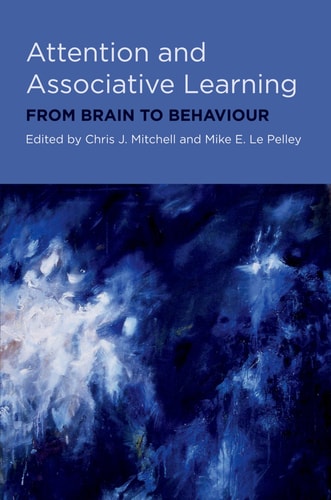
Attention and Associative Learning: From Brain to Behaviour
0
0
As an Amazon Associate and affiliate partner, Menrva Books earns from qualifying purchases. Learn more
Author Description
Attention and learning are two of the most important topics in contemporary cognitive psychology and behavioural neuroscience. Of even more interest is how the two interact. Meaningful stimuli and their meaningful effects are invariably embedded in a complex background of meaningless information. Yet, in order to learn about meaningful relationships between events, an organism needs to be able to extract the relevant from the irrelevant. The ability to direct attention selectively to some stimuli and away from others is one fundamental mechanism by which this filtering of information can occur. But what controls this selective attention? Why are certain stimuli selected and others rejected? What are the neural mechanisms underlying this ability? Are they the same in humans as in other animals? And what are the consequences of damage to this attentional system? These are the questions that this book aims to answer.The idea of an interaction between attention and learning has experienced a huge surge of interest in recent years. Advances in behavioural neuroscience have made it possible to investigate the neural basis of attention mechanisms; advances in connectionist modelling techniques have allowed us to implement and test more complex computational models of the operation of these mechanisms; and recent studies have implicated impairments in the ability to deploy selective attention appropriately in disorders such as schizophrenia and Parkinson's Disease.This book brings together leading international learning and attention researchers to provide both a comprehensive and wide-ranging overview of the current state of knowledge of this area as well as new perspectives and directions for the future. There are coherent themes that run throughout the book, but there are also, inevitably, fundamental disagreements between contributors on the role of attention in learning. Together, the views expressed in this book paint a picture of a vibrant and exciting area of psychological research, and will be essential reading for researchers of learning and attention.
Menrva's Summary
THE THESIS
This book investigates the fundamental mechanisms by which organisms selectively direct attention to relevant stimuli to facilitate associative learning. Authors Chris Mitchell and Mike Le Pelley curate a collection of contributions from leading international researchers to examine the intersection of cognitive psychology and behavioral neuroscience. The text synthesizes current knowledge regarding how neural systems filter information and how impairments in these processes manifest in clinical conditions such as schizophrenia and Parkinson's Disease. By integrating behavioral data with computational modeling, the authors provide a comprehensive framework for understanding the control of selective attention.
THE SCOPE MAP
What You Will Find
- Analysis of the neural basis of attention mechanisms across human and animal models.
- Application of connectionist modeling techniques to test computational theories of learning.
- Examination of clinical implications regarding attentional deficits in neurological and psychiatric disorders.
- Synthesis of diverse theoretical perspectives on the interaction between selective attention and associative learning.
THE AUTHORITY PERSPECTIVE
Experts recognize this volume as a comprehensive overview of the current state of research in the field of associative learning. Readers frequently note the academic density of the prose, which serves as a foundational resource for researchers and students interested in the intersection of neuroscience and cognitive psychology.
Page Count:
424
Publication Date:
2010-09-30
Publisher:
Oxford University Press
ISBN-10:
0199550530
ISBN-13:
9780199550531
Psychology
Attention
Behavioral Science
Neuroscience
Academic
Community Tags
Similar Books






Reader Comments
Share Your Thoughts
No comments yet. Be the first to share your thoughts!