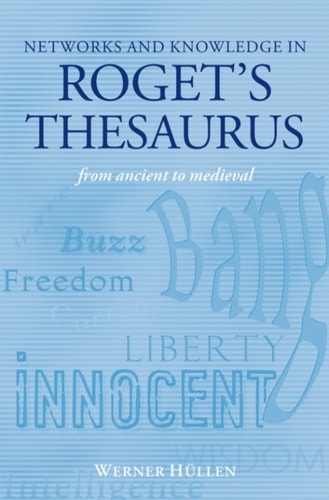
Networks and Knowledge in Roget's Thesaurus
0
0
As an Amazon Associate and affiliate partner, Menrva Books earns from qualifying purchases. Learn more
Author Description
In this book Werner Hüllen examines Roget's Thesaurus in relation to linguistics, philosophy and history. He explores the influence of Roget's Thesaurus abroad (Germany and the Romance countries). He epitomizes its history and compares the various editions of the book. In lexical case studies he evaluates some entries with pertinence to their cultural and political implications. He discusses the didactic potential of thesauri in general and considers the implications of the Thesaurus for the study of scholarly linguistics and psychology. He discusses how Roget's Thesaurus prepared the way for the more recent idea of network semantics. By analyzing retrieval techniques one can show, he claims, how the words of languages were (and are) stored in the minds of those who speak them. Professor Hüllen concludes by considering the role of synonymy in language from a perspective of cognitive linguistics showing that it is indispensable for communication.
Menrva's Summary
THE THESIS
This book investigates the historical, philosophical, and linguistic significance of Roget's Thesaurus as a foundational model for understanding human knowledge organization. Werner Hüllen, a scholar of linguistics, utilizes a comparative historical approach to analyze the evolution of the Thesaurus across various editions and international contexts. He argues that the work serves as a precursor to modern network semantics, providing a framework for how language is stored and retrieved within the human mind.
THE SCOPE MAP
What You Will Find
- Comparative analysis of multiple editions of Roget's Thesaurus
- Historical influence of the work in Germany and Romance-speaking countries
- Lexical case studies examining cultural and political implications of specific entries
- Theoretical exploration of synonymy and its role in cognitive linguistics
- Discussion on the didactic potential and retrieval techniques of thesauri
THE AUTHORITY PERSPECTIVE
Experts recognize this work as a rigorous academic examination of lexicography and its intersection with cognitive science. Readers frequently note the scholarly density of the prose, which is intended for researchers and students of historical linguistics.
Page Count:
256
Publication Date:
2009-01-15
Publisher:
Oxford University Press
ISBN-10:
0199553238
ISBN-13:
9780199553235
History
Philosophy
Linguistics
Reference
English language semantics