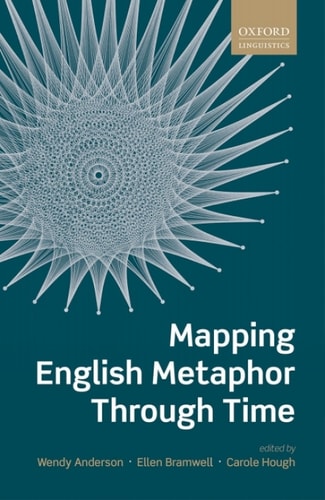
Mapping English Metaphor Through Time
0
0
As an Amazon Associate and affiliate partner, Menrva Books earns from qualifying purchases. Learn more
Author Description
This volume offers an empirical and diachronic investigation of the foundations and nature of metaphor in English. Metaphor is one of the hot topics in present-day linguistics, with a huge range of research focusing on the systematic connections between different concepts such as heat and anger (fuming, inflamed), sight and understanding (clear, see), or bodies and landscape (hill-foot, river-mouth). Until recently, the lack of a comprehensive data source made it difficult to obtain an overview of this phenomenon in any language, but this changed with the completion in 2009 of The Historical Thesaurus of English, the only historical thesaurus ever produced for any language. Chapters in this volume use this unique resource as a basis for case studies of semantic domains including Animals, Colour, Death, Fear, Food, Reading, and Theft, providing a significant step forward in the data-driven understanding of metaphor.
Menrva's Summary
THE THESIS
This volume investigates the diachronic evolution and empirical foundations of metaphor within the English language. The authors, including Carole A. Hough and Ellen Bramwell, utilize the Historical Thesaurus of English to provide a data-driven analysis of how conceptual mappings have shifted over time. By examining specific semantic domains, the text argues that metaphor is a systematic linguistic process rather than a purely creative or sporadic occurrence.
THE SCOPE MAP
What You Will Find
- Longitudinal analysis of semantic domains including Animals, Colour, Death, Fear, Food, Reading, and Theft
- Methodological application of the Historical Thesaurus of English as a primary research tool
- Empirical evidence regarding the conceptual connections between physical and abstract domains
Scope Limits
- The study is restricted to the English language and does not provide a cross-linguistic comparison
- The analysis focuses on historical semantic shifts rather than contemporary sociolinguistic usage
THE AUTHORITY PERSPECTIVE
Experts recognize this volume as a significant contribution to historical semantics due to its reliance on the Historical Thesaurus of English. Readers frequently note the academic density of the prose, making it a specialized resource for linguists and researchers in the field of historical lexicography.
Page Count:
352
Publication Date:
2016-01-01
Publisher:
OUP Oxford
ISBN-10:
0191062022
ISBN-13:
9780191062025
History
Etymology
Cognitive Linguistics
English & College Success
Semantics
English language semantics
Historical linguistics
Metaphor
European History
English
Linguistics
Community Tags
Similar Books