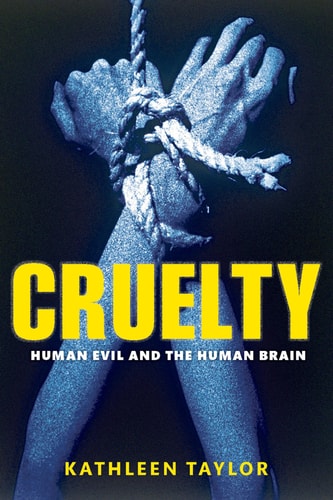
Cruelty: Human Evil and the Human Brain
0
0
As an Amazon Associate and affiliate partner, Menrva Books earns from qualifying purchases. Learn more
Author Description
In Cruelty, neuroscientist Kathleen Taylor explores the factors behind violence, sexual abuse, genocide, and other atrocities. Drawing on history, politics, philosophy, psychology, and especially neuroscience, she sets cruelty in the context of human evolution and our current understanding of brain function. She begins with an example from Lithuania in World War II, in which a young man beat a group of prisoners to death, one by one, as a crowd of civilians cheered. Can the killer and his audience be described as mentally ill? Could we ever be like them? Taylor explores the beliefs, emotions, and even instincts which can lead normally decent and law-abiding people to commit shocking acts of murder. For instance, she shows how movements begun consciously can trigger more instinctive behavior. Men who chase a victim intending to scare him may find that their brains reinterpret the chase as a hunt--and treat the victim as prey. Filled with such insight, Taylor provides a clear, nuanced and thoughtful assessment of human viciousness.
Menrva's Summary
THE THESIS
This book investigates the biological and psychological mechanisms that allow ordinary individuals to commit acts of extreme cruelty. Kathleen Taylor, a neuroscientist, synthesizes historical accounts, evolutionary biology, and cognitive science to challenge the notion that perpetrators of atrocities are inherently mentally ill. She argues that cruelty is often a product of normal brain functions operating under specific social and environmental pressures, providing a framework for understanding how human instincts can be manipulated toward violence.
THE SCOPE MAP
What You Will Find
- Analysis of the neurobiological processes that trigger aggressive behavior in social contexts.
- Examination of historical case studies, including World War II atrocities, to illustrate the transition from civilian to perpetrator.
- Exploration of how cognitive shifts, such as the reinterpretation of human targets as prey, occur within the brain.
- Integration of philosophical and psychological theories regarding the nature of evil and human morality.
THE AUTHORITY PERSPECTIVE
Experts and readers alike note the book's rigorous interdisciplinary approach, which successfully bridges the gap between complex neuroscience and accessible social commentary. The text is frequently cited for its objective, clinical tone, which avoids sensationalism while addressing deeply unsettling aspects of human nature.
Page Count:
360
Publication Date:
2009-04-30
Publisher:
Oxford University Press
ISBN-10:
0199552622
ISBN-13:
9780199552627
History
Psychology
Philosophy
Sociology
Cruelty
Neuroscience
Good & Evil
Human behavior
Community Tags
Similar Books