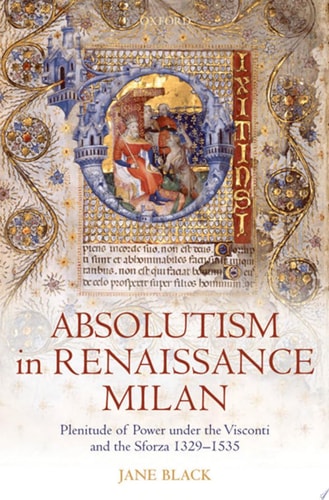
Absolutism in Renaissance Milan: Plenitude of Power under the Visconti and the Sforza 1329-1535
0
0
As an Amazon Associate and affiliate partner, Menrva Books earns from qualifying purchases. Learn more
Author Description
Absolutism in Renaissance Milan shows how authority above the law, once the preserve of pope and emperor, was claimed by the ruling Milanese dynasties, the Visconti and the Sforza, and why this privilege was finally abandoned by Francesco II Sforza (d. 1535), the last duke.As new rulers, the Visconti and the Sforza had had to impose their regime by rewarding supporters at the expense of opponents. That process required absolute power, also known as "plenitude of power," meaning the capacity to overrule even fundamental laws and rights, including titles to property. The basis for such power reflected the changing status of Milanese rulers, first as signori and then as dukes.Contemporary lawyers, schooled in the sanctity of fundamental laws, were at first prepared to overturn established doctrines in support of the free use of absolute power: even the leading jurist of the day, Baldo degli Ubaldi (d. 1400), accepted the new teaching. However, lawyers came eventually to regret the new approach and to reassert the principle that laws could not be set aside without compelling justification. The Visconti and the Sforza too saw the dangers of absolute power: as legitimate princes they were meant to champion law and justice, not condone arbitrary acts that disregarded basic rights.Jane Black traces these developments in Milan over the course of two centuries, showing how the Visconti and Sforza regimes seized, exploited and finally relinquished absolute power.
Menrva's Summary
THE THESIS
This book investigates how the Milanese dynasties of the Visconti and the Sforza claimed and eventually abandoned the concept of 'plenitude of power' to consolidate their rule between 1329 and 1535. Jane Black, a scholar of Renaissance political structures, utilizes legal records and historical documentation to analyze the evolution of absolute authority. She argues that while this power was initially necessary for regime establishment, the inherent conflict between arbitrary rule and the role of a legitimate prince eventually forced a shift toward traditional legal frameworks.
THE SCOPE MAP
What You Will Find
- A detailed examination of the political transition from signori to dukes in Renaissance Milan.
- Analysis of the legal doctrine of 'plenitude of power' and its application in property and civil rights disputes.
- Primary source evidence from the writings of contemporary jurists, including Baldo degli Ubaldi.
- A chronological study of the Visconti and Sforza dynasties spanning two centuries of governance.
THE AUTHORITY PERSPECTIVE
Historians recognize this work as a significant contribution to the study of Renaissance political theory and the practical application of law in early modern Italy. Readers frequently note the academic density of the prose, which provides a rigorous examination of the tension between autocratic ambition and the rule of law.
Page Count:
300
Publication Date:
2009-12-20
Publisher:
Oxford University Press
ISBN-10:
0199565295
ISBN-13:
9780199565290
History
Italian History
Renaissance
European History
Social Conditions
Power Social sciences
Law italy
Legal History
Sforza Family
Authoritarianism
Politics & Government
Community Tags
Similar Books