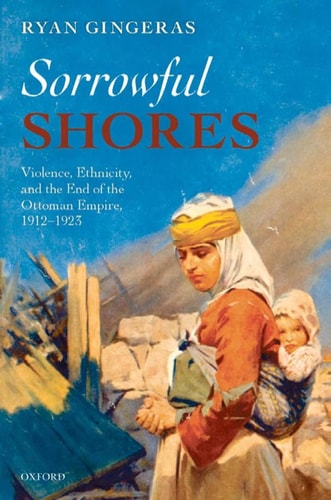
Sorrowful Shores: Violence, Ethnicity, and the End of the Ottoman Empire 1912-1923
0
0
As an Amazon Associate and affiliate partner, Menrva Books earns from qualifying purchases. Learn more
Author Description
The Turkish Republic was formed out of immense bloodshed and carnage. During the decade leading up to the end of the Ottoman Empire and the ascendancy of Mustafa Kemal Ataturk, virtually every town and village throughout Anatolia was wracked by intercommunal violence. Sorrowful Shores presents a unique, on-the-ground history of these bloody years of social and political transformation.Challenging the determinism associated with nationalist interpretations of Turkish history between 1912 and 1923, Ryan Gingeras delves deeper into this period of transition between empire and nation-state. Looking closely at a corner of territory immediately south of the old Ottoman capital of Istanbul, he traces the evolution of various communities of native Christians and immigrant Muslims against the backdrop of the Balkan Wars, the First World War, the Armenian Genocide, the Turkish War of Independence, and the Greek occupation of the region.Drawing on new sources from the Ottoman archives, Gingeras demonstrates how violence was organised at the local level. Arguing against the prevailing view of the conflict as a war between monolithic ethnic groups driven by fanaticism and ancient hatreds, he reveals instead the culpability of several competing states in fanning successive waves of bloodshed.
Menrva's Summary
THE THESIS
This work investigates the localized mechanisms of intercommunal violence that defined the transition from the Ottoman Empire to the Turkish Republic between 1912 and 1923. Ryan Gingeras, a historian specializing in the late Ottoman period, utilizes previously untapped Ottoman archival sources to challenge nationalist historiography. He argues that the widespread carnage was not the result of inevitable ancient ethnic hatreds, but rather the product of deliberate state-sponsored interventions and competing geopolitical interests that destabilized local communities.
THE SCOPE MAP
What You Will Find
- Analysis of the social and political transformation in the region south of Istanbul during the collapse of the Ottoman Empire.
- Examination of the roles played by the Balkan Wars, the First World War, and the Greek occupation in shaping local conflict.
- Evidence derived from primary Ottoman archival documents and regional administrative records.
- A critical framework that rejects monolithic ethnic explanations in favor of state-driven culpability.
THE AUTHORITY PERSPECTIVE
Historians and scholars of the Middle East recognize this text as a significant contribution to the study of the late Ottoman period due to its rigorous use of archival evidence. Readers frequently note the academic density of the prose and the author's success in providing a nuanced, localized perspective on a period often obscured by nationalist narratives.
Page Count:
272
Publication Date:
2009-04-25
Publisher:
Oxford University Press
ISBN-10:
0199561524
ISBN-13:
9780199561520
History
Military History
Ottoman Empire
Political History
Community Tags
Other Editions(3)
Similar Books