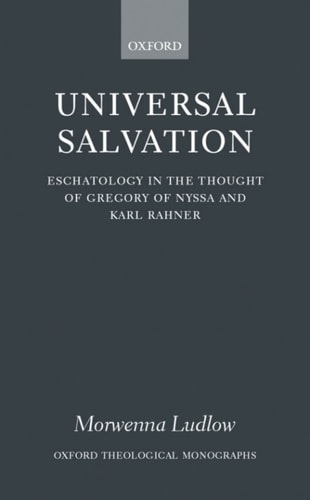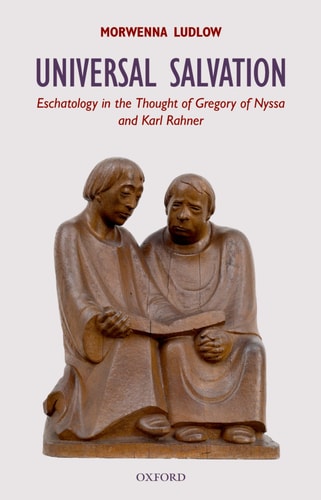
Universal Salvation: Eschatology in the Thought of Gregory of Nyssa and Karl Rahner
0
0
As an Amazon Associate and affiliate partner, Menrva Books earns from qualifying purchases. Learn more
Author Description
For nearly two thousand years Paul's suggestion at the end of 1 Corinthians 15 that God will be 'all in all' has appealed to those who hold a 'wider hope' that eventually no person will be lost from God's love. Clearly, such hope for universal salvation is at variance with most Christian tradition, which has emphasized the possibility, or certainty, of eternal hell. However, a minority of Christian thinkers have advocated the idea and it has provoked much debate in the course of the twentieth century. Responding to this interest, Morwenna Ludlow compares and assesses the arguments for universal salvation by Gregory of Nyssa and Karl Rahner - two influential theologians from very different eras who are less well known for their eschatological views.In this book Dr Ludlow gives an assessment of early Christian eschatology and its effect on modern theology by examining some fundamental questions. Does universal salvation constitute a 'second tradition' of eschatology and how has that tradition developed? What can we learn from Patristic writers such as Gregory of Nyssa? How does one approach Christian eschatology in a modern context?
Menrva's Summary
THE THESIS
This book investigates the theological viability and historical development of universal salvation by comparing the eschatological frameworks of Gregory of Nyssa and Karl Rahner. Dr. Morwenna Ludlow, a scholar of historical and systematic theology, utilizes a comparative methodology to bridge the gap between Patristic thought and modern theological inquiry. By analyzing the arguments of these two distinct thinkers, she addresses whether a consistent 'second tradition' of universalism exists within Christian history and how such a doctrine functions in contemporary discourse.
THE SCOPE MAP
What You Will Find
- A comparative analysis of Patristic eschatology versus twentieth-century theological perspectives.
- An examination of the 'wider hope' doctrine as it pertains to the concept of God being 'all in all'.
- Critical assessment of the influence of Gregory of Nyssa on modern theological debates.
- A structured inquiry into the development of universalist thought across disparate historical eras.
THE AUTHORITY PERSPECTIVE
Scholars and theologians recognize this work as a rigorous contribution to the study of Christian eschatology. Readers frequently note the academic density of the prose, which is intended for those with a background in systematic theology or historical religious studies.
Page Count:
304
Publication Date:
2009-07-15
Publisher:
Oxford University Press
ISBN-10:
0199566968
ISBN-13:
9780199566969
History
Philosophy
Religion
Eschatology
Christianity
Universalism
Theology