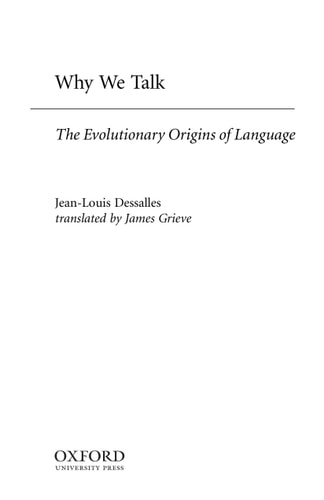
Why We Talk: The Evolutionary Origins of Language
0
0
As an Amazon Associate and affiliate partner, Menrva Books earns from qualifying purchases. Learn more
Author Description
Jean-Louis Dessalles explores the co-evolutionary paths of biology, culture, and the great human edifice of language, linking the evolution of the language to the general evolutionary history of humankind. He provides searchingly original answers to such fundamental paradoxes as to whether we acquired our greatest gift in order to talk or so as to be able to think, and as to why human beings should, as experience constantly confirms, contribute information for the well-being of others at their own expense and for no apparent gain: which if this is one of language's main functions appears to make its possession, in Darwinian terms, a disadvantage. Dr Dessalles looks for solutions in the early history of human species and considers the degree to which language evolved as a means of choosing profitable coalition partners and maximizing individual success within a competitive social environment.The author opens with a discussion of the differences between animal and human communication and the biological foundations of language. He looks at the physiological preconditions for language evolution and the early evolution of meaning and communication. He then embarks on an important and original account of the natural history of conversation. Here he considers the roles of language in supporting social cohesion and information exchange.This challenging and original account will appeal to all those interested in the origins of language and the evolution of human behaviour.
Menrva's Summary
THE THESIS
This book investigates the evolutionary origins of human language by questioning why a trait that facilitates the altruistic sharing of information would persist despite appearing to offer no immediate Darwinian advantage to the individual. Jean-Louis Dessalles, a researcher in the field of cognitive science, utilizes a framework that integrates biology, cultural evolution, and social dynamics to propose that language emerged as a tool for coalition building. By analyzing the physiological and social preconditions of early humans, he argues that language serves to maximize individual success within competitive environments.
THE SCOPE MAP
What You Will Find
- Comparative analysis of animal communication versus human linguistic capabilities.
- Examination of the physiological and biological foundations required for speech.
- Theoretical models regarding the role of conversation in maintaining social cohesion.
- Evolutionary arguments linking information sharing to the selection of profitable coalition partners.
THE AUTHORITY PERSPECTIVE
Experts recognize this work as a significant contribution to the study of language evolution, particularly for its focus on the social utility of conversation. Readers frequently note the academic density of the prose, which requires a foundational understanding of evolutionary theory to fully grasp the author's arguments.
Page Count:
388
Publication Date:
2009-08-31
Publisher:
Oxford University Press
ISBN-10:
0199563462
ISBN-13:
9780199563463
Science
Evolutionary Biology
Linguistics
Human behavior
Anthropology