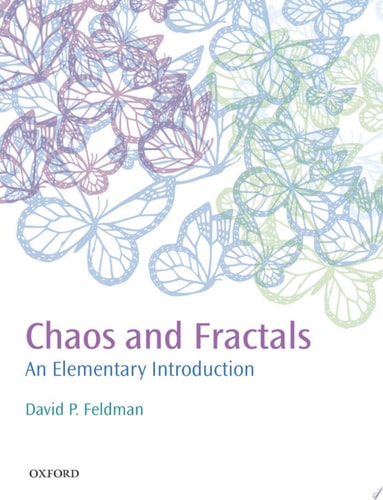
Chaos and Fractals: An Elementary Introduction
0
0
As an Amazon Associate and affiliate partner, Menrva Books earns from qualifying purchases. Learn more
Author Description
This book provides the reader with an elementary introduction to chaos and fractals, suitable for students with a background in elementary algebra, without assuming prior coursework in calculus or physics. It introduces the key phenomena of chaos - aperiodicity, sensitive dependence on initial conditions, bifurcations - via simple iterated functions. Fractals are introduced as self-similar geometric objects and analyzed with the self-similarity and box-counting dimensions. After a brief discussion of power laws, subsequent chapters explore Julia Sets and the Mandelbrot Set. The last part of the book examines two-dimensional dynamical systems, strange attractors, cellular automata, and chaotic differential equations.The book is richly illustrated and includes over 200 end-of-chapter exercises. A flexible format and a clear and succinct writing style make it a good choice for introductory courses in chaos and fractals.To request a copy of the Solutions Manual, visit: http://global.oup.com/uk/academic/physics/admin/solutions
Menrva's Summary
THE THESIS
This book investigates the fundamental principles of chaos theory and fractal geometry through an accessible, non-calculus-based framework. David P. Feldman, an experienced educator in the physical sciences, utilizes a pedagogical approach that prioritizes conceptual understanding for students with a foundation in elementary algebra. By stripping away the requirement for advanced physics or calculus, the text establishes a clear entry point into complex dynamical systems and geometric self-similarity.
THE SCOPE MAP
What You Will Find
- Iterated functions and their role in demonstrating aperiodicity and sensitive dependence on initial conditions.
- Quantitative analysis of fractals using self-similarity and box-counting dimensions.
- Exploration of Julia Sets, the Mandelbrot Set, and two-dimensional dynamical systems.
- Practical application through over 200 end-of-chapter exercises and illustrative visual models.
THE AUTHORITY PERSPECTIVE
Experts and educators frequently highlight this text as a highly effective introductory resource for undergraduate students or independent learners. Readers often note the clarity of the prose and the logical progression of topics, which makes abstract mathematical concepts manageable for those without a background in advanced calculus.
Page Count:
408
Publication Date:
2012-10-12
Publisher:
Oxford University Press
ISBN-10:
0199566437
ISBN-13:
9780199566433
Science
Earth Sciences
Chaos Theory
Mathematics
Fractals
Physics
Chaotic behavior in systems
Textbooks
Mathematical Physics
Community Tags
Similar Books