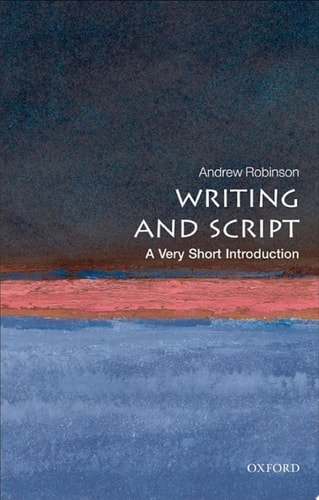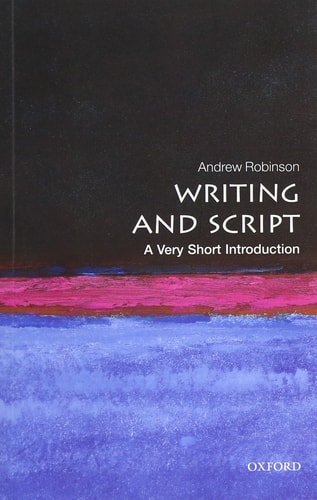
Writing and Script: A Very Short Introduction
0
0
As an Amazon Associate and affiliate partner, Menrva Books earns from qualifying purchases. Learn more
Author Description
Writing is the defining marker of civilization, without which there could be no records, no history, no books, no accumulation of knowledge. But when did this essential part of our lives begin? Why do we all write differently and how did writing evolve into what we use today? All of these questions are answered in this Very Short Introduction. Andrew Robinson tells the fascinating story of the history of writing, shedding light on its development and examining the enormous variety of writing and scripts we use today. Starting with the origins of writing five thousand years ago, with cuneiform and Egyptian hieroglyphs, Robinson explains how these early forms developed into hundreds of scripts, including the Roman alphabet and Chinese characters. He reveals how the modern writing symbols and abbreviations we take for granted today--including airport signage and text messaging--resemble ancient ones much more closely than we might think. The book also includes a chronology of events from 3300 BC to AD 2000, a list of titles for further reading, and an index.About the Series: Combining authority with wit, accessibility, and style, Very Short Introductions offer an introduction to some of life's most interesting topics. Written by experts for the newcomer, they demonstrate the finest contemporary thinking about the central problems and issues in hundreds of key topics, from philosophy to Freud, quantum theory to Islam.
Menrva's Summary
THE THESIS
This book investigates the origins, evolution, and cultural significance of writing systems as the foundational technology of human civilization. Andrew Robinson, an expert in the history of scripts and ancient civilizations, utilizes archaeological evidence and linguistic analysis to trace the development of communication from early cuneiform to contemporary digital symbols. He argues that writing is not merely a static tool but a dynamic, evolving system that reflects the changing needs of human societies across five millennia.
THE SCOPE MAP
What You Will Find
- A comprehensive historical timeline spanning from 3300 BC to AD 2000.
- Comparative analysis of major writing systems including cuneiform, Egyptian hieroglyphs, and the Roman alphabet.
- Examination of the structural evolution of scripts and their adaptation into modern signage and digital communication.
- Scholarly synthesis of how ancient symbolic representation informs current literacy and information storage.
THE AUTHORITY PERSPECTIVE
Experts and readers alike identify this work as an accessible, high-level primer for those seeking a concise overview of paleography and the history of communication. The text is frequently praised for its ability to distill complex linguistic history into a readable format without sacrificing academic rigor.
Page Count:
157
Publication Date:
2009-01-01
Publisher:
Oxford University Press
ISBN-10:
0199567786
ISBN-13:
9780199567782
History
Non-Fiction
Linguistics
Writing history
Reference