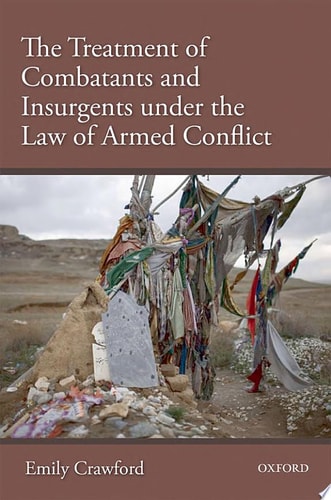
The Treatment of Combatants under the Law of Armed Conflict
Author Description
This book makes the case for eliminating the distinction between types of armed conflict under international humanitarian law (IHL), specifically as they apply to persons taking a direct part in the hostilities - be they soldiers or insurgents. Currently, IHL makes a distinction between international and non-international armed conflicts. International armed conflicts are regulated by more treaties than their non-international counterparts. The regulation of international armed conflicts is also considerably more comprehensive than that offered for participants in and victims of non-international armed conflicts. This bifurcation of the law was logical at the time the Geneva Conventions of 1949 were drafted and adopted, as the majority of armed conflicts prior to that point had been international in character. However, in the years following the adoption of the Conventions, there has been a proliferation of non-international armed conflicts, which presents challenges to a body of law that has few tools to adequately address such occurrences. The adoption of the Additional Protocols in 1977 went some way to addressing the legal lacunae that existed, but significant gaps still remain.Mindful of this history, this book tracks the growth and evolution of the laws of armed conflict in the modern era, since the first document of the laws of war produced for the American Civil War. In doing so, this book demonstrates how the law of armed conflict has become increasingly harmonized in its application, with more rules of IHL being generally applicable in all instances of armed conflict, regardless of characterization. This book then makes the argument that the time has come for the final step to be taken, the elimination of the distinction between types of armed conflict, and the complete harmonization of the laws of war. Focusing specifically on the issue of combatants and POWs in armed conflicts, and drawing on the recent US treatment of detainees in Guantanamo Bay in the "War on Terror", this book draws on considerable legal precedent, legal theory, and policy arguments to make the case that it is time for the law relating to the regulation of armed conflicts to be more uniformly applied.
Menrva's Summary
THE THESIS
This book investigates whether the legal distinction between international and non-international armed conflicts remains viable or if it should be eliminated to ensure consistent application of international humanitarian law. Emily Crawford, an expert in international law, examines the historical evolution of the Geneva Conventions and subsequent protocols to argue that the current bifurcation of legal standards is outdated. By analyzing the shift in the nature of modern warfare, the author proposes a comprehensive harmonization of the laws of war to better protect combatants and detainees.
THE SCOPE MAP
What You Will Find
- Historical analysis of the Geneva Conventions and the 1977 Additional Protocols.
- Examination of the legal status of combatants and prisoners of war in modern conflicts.
- Case study of United States detention practices at Guantanamo Bay.
- Legal argument for the unification of international humanitarian law standards.
THE AUTHORITY PERSPECTIVE
Legal scholars and practitioners recognize this work as a significant contribution to the discourse on the modernization of international humanitarian law. Readers frequently note the academic density of the prose and the author's rigorous approach to reconciling historical legal frameworks with contemporary conflict realities.
Page Count:
250
Publication Date:
2010-03-12
Publisher:
Oxford University Press
ISBN-10:
0199578966
ISBN-13:
9780199578962
Law
International Law
Human rights
Military History
Community Tags
Similar Books

Reader Comments
Share Your Thoughts
No comments yet. Be the first to share your thoughts!