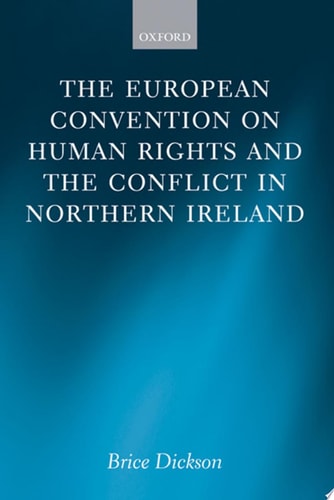
The European Convention on Human Rights and the Conflict in Northern Ireland
0
0
As an Amazon Associate and affiliate partner, Menrva Books earns from qualifying purchases. Learn more
Author Description
European Conflict on Human Rights and the Conflict in Northern Ireland, provides the first comprehensive account of the role played by the European Convention on Human Rights during the conflict in Northern Ireland from 1968. Brice Dickson studies the effectiveness of the Convention in protecting human rights in a society wracked by terrorism and deep political conflict, detailing the numerous applications lodged at Strasbourg relating to the conflict and considering how they were dealt with by the enforcement bodies. The book illustrates the limitations inherent in the Convention system but also demonstrates how the European Commission and Court of Human Rights gradually developed a more interventionist approach to the applications emanating from Northern Ireland. In turn this allowed the Convention to become a more secure guarantor of basic rights and freedoms during times of extreme civil unrest and political turmoil elsewhere in Europe.The topics examined include the right to life, the right not to be ill-treated, the right to liberty, the right to a fair trial, the right to a private life, the right to freedom of belief, the right to freedom of expression, the right to freedom of assembly, and the right not to be discriminated against. The book argues that, while eventually the European Court did use the applications from Northern Ireland to establish important human rights principles, their development was slow and arduous and some gaps in protection still remain. The book illustrates the limits of the European Convention as a tool for protecting human rights in times of crisis.
Menrva's Summary
THE THESIS
This book investigates the efficacy of the European Convention on Human Rights (ECHR) as a legal mechanism for safeguarding fundamental rights during the protracted civil unrest and political violence in Northern Ireland. Brice Dickson, a legal scholar, utilizes extensive case law and records of applications lodged at Strasbourg to evaluate how international enforcement bodies navigated the complexities of a society defined by terrorism and sectarian conflict. The author argues that while the Convention eventually established critical human rights precedents, the process was characterized by slow institutional development and persistent gaps in protection.
THE SCOPE MAP
What You Will Find
- A comprehensive analysis of applications lodged at the European Commission and Court of Human Rights from 1968 onwards.
- Examination of specific legal rights including the right to life, liberty, fair trial, and freedom of expression.
- A critical assessment of the transition from a passive to an interventionist judicial approach by European enforcement bodies.
- Evaluation of the limitations of international human rights law during periods of extreme civil crisis.
THE AUTHORITY PERSPECTIVE
Legal scholars and historians recognize this work as a foundational text for understanding the intersection of international human rights law and regional conflict. Experts frequently highlight the book's meticulous documentation of Strasbourg case law as an essential resource for those studying the evolution of European legal standards.
Page Count:
445
Publication Date:
2010-04-30
Publisher:
Oxford University Press
ISBN-10:
0199571384
ISBN-13:
9780199571383
History
Law
Northern Ireland
Human rights
Professional Career & Trade
Community Tags
Similar Books