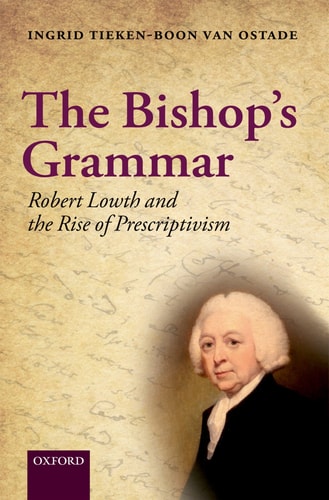
The Bishop's Grammar: Robert Lowth and the Rise of Prescriptivism
0
0
As an Amazon Associate and affiliate partner, Menrva Books earns from qualifying purchases. Learn more
Author Description
This spirited account of the life and times of one of the seminal figures in history of English grammar dispels the myth of Lowth as the icon of prescriptivism, and establishes him as the most important figure in eighteenth-century English grammar.Ingrid Tiecken-Boon van Ostade reexamines the life and work of Robert Lowth (1710-1787), founder of the grammatical prescriptivism so deprecated by modern linguists and educational theorists. She considers Lowth and his grammar in the context of his times and from the perspective of his aims and readership. She shows that, once the grammar had been accepted for publication, it developed into a publishers' project similar to Samuel Johnson's Dictionary of the English Language to which it was intended as a complement. Professor Tiecken draws on contemporary sources, including Lowth's extensive correspondence and unpublished memoir, to explore the social networks, aspirations, beliefs, and reading habits that informed and shaped his grammar and ideas on language. (She notes that Lowth's own language often falls short of the norms and strictures advanced in his book.) By comparing the grammar - in particular the problems of usage dealt with in its sections on syntax - with guides from the nineteenth and twentieth centuries, she redefines Lowth's seminal position in the history of handbooks for correct usage, as well as his role in the establishment of the canon of prescriptivism.This book will appeal to all those interested in the history of English, the role of language in the Enlightenment, and the long-running debate on linguistic correctness and the merits or otherwise of prescriptive rules in the teaching and use of English.
Menrva's Summary
THE THESIS
This work investigates the historical origins of English grammatical prescriptivism by re-evaluating the life and influence of Robert Lowth. Ingrid Tieken-Boon van Ostade, a scholar of historical linguistics, utilizes primary source documents including Lowth's private correspondence and unpublished memoirs to challenge the prevailing academic caricature of Lowth as a rigid linguistic tyrant. By situating his work within the eighteenth-century Enlightenment context, the author demonstrates that Lowth's grammar was a complex publishing endeavor intended to complement Samuel Johnson's dictionary rather than a simple manifesto for linguistic restriction.
THE SCOPE MAP
What You Will Find
- An analysis of eighteenth-century social networks and the intellectual aspirations of the Enlightenment era.
- A comparative study of Lowth's syntax rules against subsequent nineteenth and twentieth-century usage guides.
- Evidence derived from personal correspondence, unpublished memoirs, and contemporary publishing records.
- A re-examination of the development of the English grammatical canon and the evolution of prescriptive norms.
THE AUTHORITY PERSPECTIVE
Scholars and linguists recognize this text as a critical revisionist history that successfully complicates the narrative surrounding the origins of English prescriptivism. Readers frequently note the academic density of the prose, which provides a rigorous, evidence-based look at the intersection of social history and linguistic theory.
Page Count:
352
Publication Date:
2011-01-07
Publisher:
Oxford University Press
ISBN-10:
019957927X
ISBN-13:
9780199579273
Non-Fiction
Biography
History
English language standardization
Linguistics
Community Tags
Similar Books