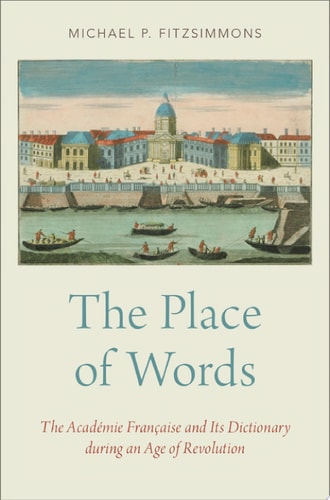
The Place of Words: The Académie Française and Its Dictionary during an Age of Revolution
0
0
As an Amazon Associate and affiliate partner, Menrva Books earns from qualifying purchases. Learn more
Author Description
As the tricolor rose over revolutionary France, language, with its ability to define ideals and allegiances, was both a threat to authority and weapon to be wielded. In the early years of the Republic, the Académie Française, the royal body responsible for the French language, was suppressed by the National Convention at the urging of the Abbé Grégoire and the artist Jacques-Louis David. However, by 1795, the National Convention recognized that language could be used to its advantage, leading it to commission a fifth edition of the Dictionnaire de l'Académie française, which would unquestionably become the most controversial edition in the Académie's history. The National Convention expected this dictionary to champion the ideals of Revolution and Republic, but when it appeared three years later it did quite the opposite. Instead, the fifth edition virtually ignored the Revolution and the linguistic innovations that had transformed the French language, even omitting two of the most famous and enduring neologisms spawned by the Revolution--ancien régime and Terror. Present-tense definitions of abolished institutions and anachronistic values dominated the work and the Revolution was consigned to a brief and hastily-prepared supplement at the end of the second volume. Because of its failure to capture the current state of the French language, most contemporaries judged it harshly, and its deficiencies led the Parisian publisher Nicolas Moutardier to publish a competing dictionary in 1802. The dictionary became the focus of protracted litigation that Napoleon Bonaparte's government increasingly used to assert its control over language. Indeed, Bonaparte met personally with the commission of the Institut National (the republican successor to the Académie) and made clear his desire that the new edition not contain revolutionary neologisms. Eager to see the new edition appear, the Bonapartist regime committed financial resources and established a timetable for its completion.
Menrva's Summary
THE THESIS
This work investigates how the Académie Française and its fifth dictionary edition became a battleground for political legitimacy and linguistic control during the French Revolution. Michael P. Fitzsimmons, a historian specializing in the French Revolution, utilizes archival records and the specific text of the 1798 dictionary to argue that the institution intentionally resisted revolutionary linguistic shifts. By examining the tension between the National Convention's expectations and the Académie's conservative output, the author demonstrates how language served as a proxy for broader ideological conflicts regarding the state's authority.
THE SCOPE MAP
What You Will Find
- Analysis of the 1798 fifth edition of the Dictionnaire de l'Académie française
- Documentation of the legal and political conflict between the Académie and the National Convention
- Examination of the influence of Napoleon Bonaparte on linguistic standardization
- Comparison between the official dictionary and the competing 1802 publication by Nicolas Moutardier
Scope Limits
- The study does not provide a comprehensive history of the French language across all centuries
- It focuses primarily on the political and institutional aspects of lexicography rather than purely etymological evolution
THE AUTHORITY PERSPECTIVE
Scholars recognize this text as a significant contribution to the study of revolutionary-era cultural politics and the institutionalization of language. Readers frequently note the academic density of the prose, which provides a detailed look at the intersection of state power and intellectual tradition.
Page Count:
275
Publication Date:
2017-01-01
Publisher:
Oxford University Press
ISBN-10:
0190644559
ISBN-13:
9780190644550
History
Political History
French language
French History
Linguistics
English & College Success
Cultural History
English
18th century
European History
Community Tags
Similar Books