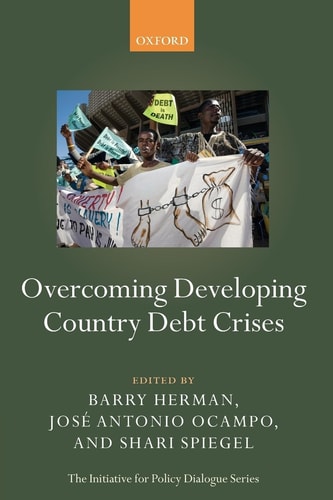
Overcoming Developing Country Debt Crises
0
0
As an Amazon Associate and affiliate partner, Menrva Books earns from qualifying purchases. Learn more
Author Description
Developing country debt crises have been a recurrent phenomenon over the past two centuries. In recent times sovereign debt insolvency crises in developing and emerging economies peaked in the 1980s and, again, from the middle 1990s to the start of the new millennium. Despite the fact that several developing countries now have stronger economic fundamentals than they did in the 1990s, sovereign debt crises will reoccur again. The reasons for this are numerous, but the central one is that economic fluctuations are inherent features of financial markets, the boom and bust nature of which intensify under liberalized financial environments that developing countries have increasingly adopted since the 1970s. Indeed, today we are in the midst of an almost unprecedented global "bust."The timing of the book is important. The conventional wisdom is that the international economic and financial system is broken. Policymakers in both the poorest and the richest countries are likely to seriously consider how to restructure the international trade and financial system, including how to resolve sovereign debt crises in a more effective and fair manner.This book calls for the international reform of sovereign debt workouts which derives from both economic theory and real-world experiences. Country case studies underline the point that we need to do better. This book recognizes that the politics of the international treatment of sovereign debt have not supported systemic reform efforts thus far; however, failure in the past does not preclude success in the future in an evolving international political environment, and the book thus puts forth alternative reform ideas for consideration.
Menrva's Summary
THE THESIS
This book investigates the recurring phenomenon of sovereign debt crises in developing nations and proposes systemic reforms to the international financial architecture. The authors, affiliated with the Initiative for Policy Dialogue, leverage economic theory and historical case studies to argue that the inherent boom-and-bust cycles of liberalized financial markets necessitate a more effective and equitable framework for debt restructuring. By analyzing past failures in international debt treatment, the text provides a roadmap for policymakers to navigate the complexities of global economic volatility.
THE SCOPE MAP
What You Will Find
- Historical analysis of sovereign debt insolvency crises from the 1980s through the early 2000s.
- Theoretical frameworks explaining the relationship between liberalized financial environments and economic instability.
- Comparative country case studies illustrating the practical limitations of current debt workout mechanisms.
- Proposed policy alternatives for restructuring the international trade and financial system to better support developing economies.
THE AUTHORITY PERSPECTIVE
Experts and policymakers frequently cite this work as a critical contribution to the discourse on international financial reform. Readers often note the academic rigor and the clear, evidence-based approach the authors employ to address complex macroeconomic challenges.
Page Count:
424
Publication Date:
2010-05-26
Publisher:
Oxford University Press
ISBN-10:
0199578796
ISBN-13:
9780199578795
Economics
Finance
Debts External
Developing Countries
International relations
Community Tags
Other Editions(2)
Similar Books


Reader Comments
Share Your Thoughts
No comments yet. Be the first to share your thoughts!