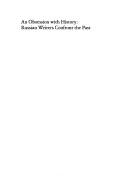
An Obsession with History
0
0
As an Amazon Associate and affiliate partner, Menrva Books earns from qualifying purchases. Learn more
Author Description
Russians have frequently seemed transfixed by the idea of the singularity of their own history and by the relationship of that history to the history of the outside world. In particular, three notions stand out, related to each other to be sure, but by no means unproblematically so. First of all, there is the conviction of absolute difference; Russians insist, even in the face of evidence to the contrary - that their nation's past is unlike that of any other country. Second is the belief that Russia will somehow be able to overcome history, to jump out of time as it were, and thereby escape the strong allure of her history. And third is the frequent assertion that although all may not be well with her in the present, Russia's unusual past ensures that she will have a unique role to play in the future; she is the messiah among nations whose time will come after the apocalyptic crash of the present order. The author traces the role of Russian literature over two hundred years in creating and sustaining these three notions. He shows that, contrary to European practice, Russian writers of belles lettres in the nineteenth and twentieth centuries never abdicated the right to define the nation's past. Indeed, Russia's major writers - from Catherine the Great through Karamzin, Pushkin, Gogol, Tolstoy, Dostoevsky, Khlebnikov, Tynianov, and Solzhenitsyn - have felt it incumbent upon them to produce works on historical themes. However, rather than assert the primacy of poetic experience, they all produced complementary texts on the same historical subject, one text claiming to be non-fictional and one text claiming to be "poetic." This approach allowed the writers to exploit the differences in tone, approach, and authority that by convention have separated imaginative literature and history. The result is a tradition of intergeneric dialogue, in which a chosen historical period is illuminated through multiple, competing narrative perspectives. The author describes the de
Menrva's Summary
THE THESIS
This book investigates the persistent and often paradoxical ways Russian history has been perceived and articulated, both internally and in relation to the wider world. Andrew Wachtel examines how Russian literature, over two centuries, has shaped three core notions: the absolute uniqueness of Russian history, the belief in Russia's ability to transcend history, and the conviction of a unique future role for Russia. The author demonstrates how prominent Russian writers, from Catherine the Great to Solzhenitsyn, actively engaged with historical themes, producing both fictional and non-fictional accounts that created a dynamic dialogue between literature and history.
THE SCOPE MAP
- Exploration of the concept of Russia's absolute historical difference from other nations.
- Analysis of the belief in Russia's capacity to 'overcome' or 'jump out of' history.
- Examination of the idea that Russia's unique past guarantees a special future role.
- Traces the role of Russian literature in creating and sustaining these national historical myths.
- Highlights the engagement of major Russian writers (Pushkin, Tolstoy, Dostoevsky, etc.) with historical themes.
- Discusses the tradition of writers producing both 'non-fictional' and 'poetic' texts on the same historical subjects.
- Analyzes the exploitation of the conventional separation between imaginative literature and history.
- Describes a tradition of intergeneric dialogue illuminating historical periods through competing narrative perspectives.
THE AUTHORITY PERSPECTIVE
The book examines the complex relationship between Russian literature and the nation's historical self-perception, focusing on recurring themes of uniqueness, transcendence, and a destined future role. It highlights how prominent Russian writers actively shaped these narratives through a unique intergeneric dialogue between fictional and non-fictional historical accounts. The work is noted for its deep engagement with a wide range of Russian literary figures and its analysis of how literary texts have historically defined Russia's place in the world. This approach reveals a consistent pattern in Russian thought regarding its own historical trajectory.
Page Count:
276
Publication Date:
1995-01-01
ISBN-10:
0804725942
ISBN-13:
9780804725941
History
Non-Fiction
Literary Criticism
Russian
Community Tags
Similar Books