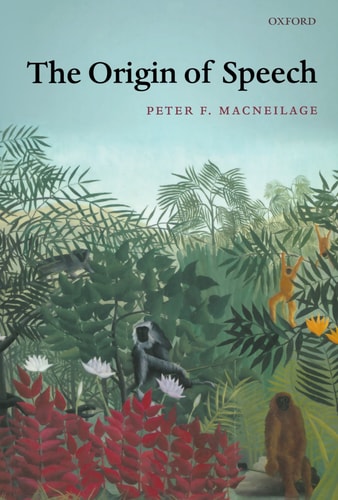
The Origin of Speech
0
0
As an Amazon Associate and affiliate partner, Menrva Books earns from qualifying purchases. Learn more
Author Description
This book explores the origin and evolution of speech. The human speech system is in a league of its own in the animal kingdom and its possession dwarfs most other evolutionary achievements. During every second of speech we unconsciously use about 225 distinct muscle actions. To investigate the evolutionary origins of this prodigious ability, Peter MacNeilage draws on work in linguistics, cognitive science, evolutionary biology, and animal behaviour. He puts forward a neo-Darwinian account of speech as a process of descent in which ancestral vocal capabilities became modified in response to natural selection pressures for more efficient communication. His proposals include the crucial observation that present-day infants learning to produce speech reveal constraints that were acting on our ancestors as they invented new words long ago.This important and original investigation integrates the latest research on modern speech capabilities, their acquisition, and their neurobiology, including the issues surrounding the cerebral hemispheric specialization for speech. It will interest a wide range of readers in cognitive, neuro-, and evolutionary science, as well as all those seeking to understand the nature and evolution of speech and human communication.
Menrva's Summary
THE THESIS
This book investigates the evolutionary origins of human speech by proposing a neo-Darwinian framework that explains how ancestral vocal capabilities were modified through natural selection to achieve efficient communication. Peter MacNeilage, a specialist in the field, synthesizes data from linguistics, cognitive science, and animal behavior to argue that speech is a unique evolutionary achievement. He posits that the constraints observed in infant language acquisition provide a window into the selective pressures that shaped the development of early human vocalization.
THE SCOPE MAP
What You Will Find
- A neo-Darwinian analysis of speech evolution and descent.
- Integration of neurobiological research regarding cerebral hemispheric specialization.
- Comparative studies of animal vocalization versus human speech capabilities.
- Examination of infant speech acquisition as a model for ancestral linguistic development.
THE AUTHORITY PERSPECTIVE
Experts recognize this work as a significant contribution to the study of language evolution, particularly for its interdisciplinary approach. Readers frequently note the academic density of the prose, which makes it a foundational text for those interested in the intersection of biology and linguistics.
Page Count:
408
Publication Date:
2010-03-12
Publisher:
Oxford University Press
ISBN-10:
0199581584
ISBN-13:
9780199581580
Science
Anthropology
Linguistics
Evolutionary Biology
Community Tags
Other Editions(3)
Similar Books