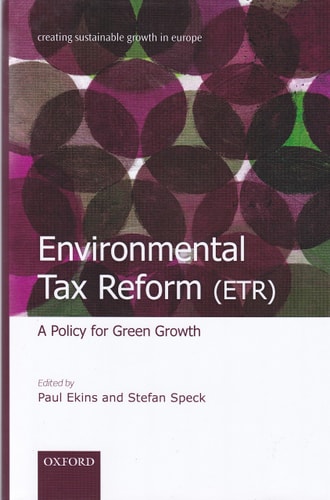
Environmental Tax Reform: A Policy for Green Growth
0
0
As an Amazon Associate and affiliate partner, Menrva Books earns from qualifying purchases. Learn more
Author Description
Many people have serious concerns about the environment and wonder whether solving environmental problems is compatible with continuing economic growth. This book provides an in-depth exploration of a proposed reform to the national tax system, whereby the burden of taxes is shifted from conventional taxes, such as those levied on labour and capital, to taxes on environmentally related activities, that involve resource use, particularly energy, or environmental pollution. There is some experience of such 'environmental tax reform' (ETR) in Europe, and the book briefly reviews this before considering how a more ambitious ETR in Europe could substantially reduce greenhouse gas emissions and material flows through the economy, while stimulating innovation and investment in the key 'clean and green' sectors of the economy which seem likely to play an increasing part in the creation of prosperity in Europe and elsewhere in the future.Case studies of renewable energy, construction, fuel-efficient vehicles, and waste management in Germany show how these fast-growing sectors are making an increasing contribution to employment, output, and exports in the German economy, while improving the environment. The book explores the implications of introducing it on a much wider scale throughout the European Union. A unique modelling exercise, using two macroeconomic models, delivers varied and complementary insights into the economic and environmental results of a large-scale ETR in Europe, and its effects on and implications for the rest of the world. The modelling suggests that such a policy has a key role in the achievement of Europe's targets to reduce its greenhouse gas emissions, and, if implemented with cooperative policy in other countries, could significantly reduce global emissions.The book is essential and hopeful reading for anyone who has wondered how, with today's intensifying environmental challenges, economic growth could become more environmentally sustainable.
Menrva's Summary
THE THESIS
This book investigates whether shifting the national tax burden from labor and capital to environmentally damaging activities can reconcile economic growth with urgent environmental sustainability. Authors Paul Ekins and Stefan Speck utilize their expertise in environmental economics to evaluate the potential of Environmental Tax Reform (ETR) across the European Union. By analyzing existing European policies and employing advanced macroeconomic modeling, the authors argue that such a fiscal shift can simultaneously reduce greenhouse gas emissions and stimulate innovation in clean technology sectors.
THE SCOPE MAP
What You Will Find
- Analysis of environmental tax reform implementation across various European nations.
- Macroeconomic modeling exercises assessing the impact of large-scale tax shifts on global emissions.
- Case studies focusing on renewable energy, construction, fuel-efficient vehicles, and waste management in Germany.
- Evaluation of the relationship between environmental policy, employment rates, and industrial output.
THE AUTHORITY PERSPECTIVE
Experts recognize this work as a rigorous contribution to the discourse on green fiscal policy and sustainable economic development. Readers frequently note the technical density of the macroeconomic modeling, which provides a robust quantitative foundation for the authors' policy recommendations.
Page Count:
368
Publication Date:
2011-05-26
Publisher:
Oxford University Press
ISBN-10:
0199584508
ISBN-13:
9780199584505
Economics
Sustainability
Taxation
Green Growth
Europe
Community Tags
Similar Books