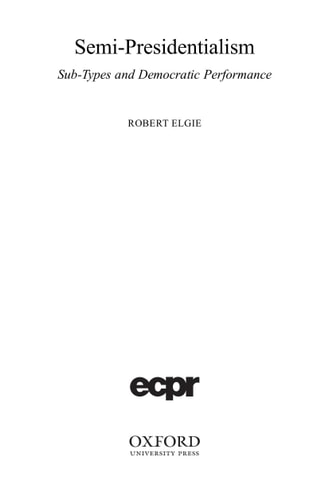
Semi-Presidentialism: Sub-Types and Democratic Performance
0
0
As an Amazon Associate and affiliate partner, Menrva Books earns from qualifying purchases. Learn more
Author Description
In this book, Robert Elgie examines the relationship between semi-presidentialism and democratic performance. Semi-presidentialism--where a constitution provides for both a directly elected president and a prime minister and cabinet responsible to the legislature--has become the regime type of choice for new democracies. There are now over 50 countries in the world with a semi-presidential constitution and the vast majority of these countries have chosen this form of government since the early 1990s. Semi-Presidentialism operationalizes Shugart and Carey's distinction between president-parliamentarism--where the prime minister is responsible to both the legislature and to the directly elected president--and premier-presidentialism--where the prime minister is responsible to the legislature alone. The book shows that, all else equal, the president-parliamentary sub-type is more likely to be associated with a poorer democratic performance than its premier-presidential counterpart. The evidence is based on a mixed-method approach, including large-n comparative statistical studies of all semi-presidential democracies since 1919, as well as in-depth case studies.Comparative Politics is a series for students, teachers, and researchers of political science that deals with contemporary government and politics. Global in scope, books in the series are characterised by a stress on comparative analysis and strong methodological rigour. The series is published in association with the European Consortium for Political Research.
Menrva's Summary
THE THESIS
This book investigates the correlation between specific sub-types of semi-presidential government and the resulting quality of democratic performance in nations worldwide. Robert Elgie, a prominent scholar in the field of comparative politics, utilizes a rigorous analytical framework to distinguish between president-parliamentarism and premier-presidentialism. By examining data from over 50 countries, Elgie argues that the structural design of executive responsibility significantly influences the stability and health of democratic institutions. The study provides a systematic evaluation of how constitutional arrangements impact governance outcomes.
THE SCOPE MAP
What You Will Find
- A comprehensive comparative analysis of semi-presidential democracies dating back to 1919.
- A clear methodological distinction between president-parliamentarism and premier-presidentialism.
- Large-n statistical studies paired with in-depth qualitative case studies.
- An assessment of how executive-legislative relations affect democratic performance.
THE AUTHORITY PERSPECTIVE
Experts in political science recognize this work as a foundational text for understanding the nuances of executive power in modern democracies. Readers frequently note the academic density of the prose and the high level of methodological rigor applied to the comparative data sets.
Page Count:
296
Publication Date:
2011-10-15
Publisher:
Oxford University Press
ISBN-10:
0199585989
ISBN-13:
9780199585984
Cabinet system
International relations
Democracy
Government
Comparative Politics
Community Tags
Similar Books