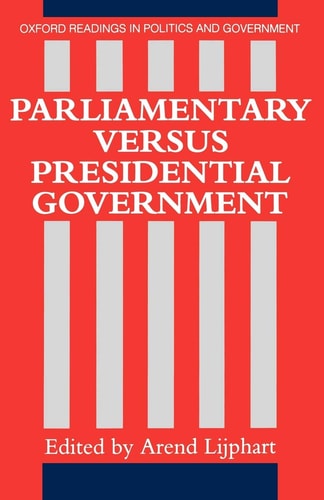
Parliamentary versus Presidential Government
0
0
As an Amazon Associate and affiliate partner, Menrva Books earns from qualifying purchases. Learn more
Author Description
Parliamentary and presidential governments--exemplified by most European countries for the former and the United States and Latin America for the latter--are the two principal forms of democracy in the modern world. Their respective advantages and disadvantages have been long debated, at first mainly by British and American political observers but with increasing frequency in other parts of the world, especially in Latin America, but also in Western and Eastern Europe and Asia. The recent world-wide wave of democratization has intensified both the debate and its significance. This volume brings together the most important statement on the subject by advocates and analysts--from Montesquieu and Madison to Lipset and Linz. It also treats the merits of less frequently used democratic types, such as French-style semi-presidentialism, that may be regarded as intermediate forms between parliamentarism and presidentialism.
Menrva's Summary
THE THESIS
This volume investigates the comparative merits and structural differences between parliamentary and presidential systems of government. Arend Lijphart, a prominent scholar in comparative politics, curates a collection of foundational texts to analyze how these democratic frameworks function across diverse global contexts. The work synthesizes historical perspectives and contemporary political theory to evaluate the stability and efficacy of these governance models.
THE SCOPE MAP
What You Will Find
- Comparative analysis of parliamentary and presidential democratic systems
- Historical perspectives from political theorists including Montesquieu and Madison
- Examination of intermediate forms such as semi-presidentialism
- Discussion of democratic transitions in Europe, Latin America, and Asia
THE AUTHORITY PERSPECTIVE
Experts recognize this collection as a foundational resource for students and scholars of comparative government. Readers frequently note the academic density of the prose and the comprehensive nature of the selected essays.
Page Count:
272
Publication Date:
1992-04-02
Publisher:
Oxford University Press
ISBN-10:
0198780443
ISBN-13:
9780198780441
Politics
Government
Comparative Government
Comparative Politics
Representative government and representation
Democracy
Cabinet system
Community Tags
Other Editions(3)

Similar Books