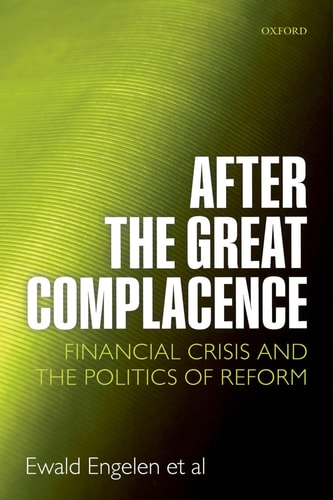
After the Great Complacence: Financial Crisis and the Politics of Reform
0
0
As an Amazon Associate and affiliate partner, Menrva Books earns from qualifying purchases. Learn more
Author Description
What is the relationship between the financial system and politics? In a democratic system, what kind of control should elected governments have over the financial markets? What policies should be implemented to regulate them? What is the role played by different elites--financial, technocratic, and political--in the operation and regulation of the financial system? And what role should citizens, investors, and savers play?These are some of the questions addressed in this challenging analysis of the particular features of the contemporary capitalist economy in Britain, the USA, and Western Europe. The authors argue that the causes of the financial crisis lay in the bricolage and innovation in financial markets, resulting in long chains and circuits of transactions and instruments that enabled bankers to earn fees, but which did not sufficiently take into account system risk, uncertainty, and unintended consequences.In the wake of the crisis, the authors argue that social scientists, governments, and citizens need to re-engage with the political dimensions of financial markets. This book offers a controversial and accessible exploration of the disorders of our financial capitalism and its justifications. With an innovative emphasis on the economically 'undisclosed' and the political 'mystifying', it combines technical understanding of finance, cultural analysis, and al political account of interests and institutions.
Menrva's Summary
THE THESIS
This work investigates the systemic relationship between financial markets, political governance, and the failure of regulatory mechanisms in the wake of the global financial crisis. The authors, a collaborative team of researchers, utilize a framework that combines technical financial analysis with cultural and institutional critique to examine the capitalist economies of Britain, the USA, and Western Europe. They argue that the crisis was precipitated by excessive financial innovation and complex transaction chains that prioritized fee generation over systemic risk management, necessitating a renewed political engagement with market regulation.
THE SCOPE MAP
What You Will Find
- Analysis of financial market innovation and the resulting systemic risks in Western economies.
- Examination of the roles played by financial, technocratic, and political elites in market operations.
- Critique of the 'undisclosed' economic practices and 'mystifying' political justifications for current financial structures.
- Discussion on the democratic control of financial markets and the agency of citizens, investors, and savers.
THE AUTHORITY PERSPECTIVE
Experts recognize this text as a critical contribution to the political economy of finance, noting its interdisciplinary approach to understanding market disorders. Readers frequently highlight the authors' ability to bridge the gap between technical financial mechanics and broader political theory, making it a significant resource for those studying the intersection of policy and capital.
Page Count:
256
Publication Date:
2011-11-29
Publisher:
Oxford University Press
ISBN-10:
0199589089
ISBN-13:
9780199589081
Economics
Finance
Finance Public
Public Administration
Capitalism
Financial Services Industry
Public Policy
Community Tags
Similar Books







Reader Comments
Share Your Thoughts
No comments yet. Be the first to share your thoughts!