
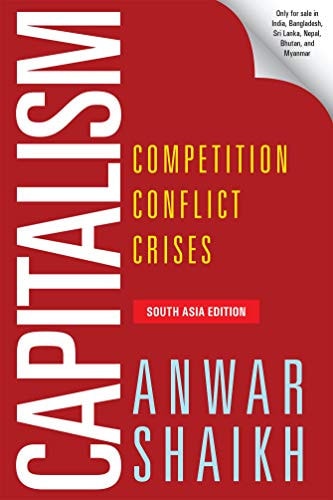
Capitalism: Competition, Conflict, Crises
0
0
As an Amazon Associate and affiliate partner, Menrva Books earns from qualifying purchases. Learn more
Author Description
Orthodox economics operates within a hypothesized world of perfect competition in which perfect consumers and firms act to bring about supposedly optimal outcomes. The discrepancies between this model and the reality it claims to address are then attributed to particular imperfections in reality itself. Most heterodox economists seize on this fact and insist that the world is characterized by imperfect competition. But this only ties them to the notion of perfect competition, which remains as their point of departure and base of comparison. There is no imperfection without perfection. In Capitalism, Anwar Shaikh takes a different approach. He demonstrates that most of the central propositions of economic analysis can be derived without any reference to standard devices such as hyperrationality, optimization, perfect competition, perfect information, representative agents, or so-called rational expectations. This perspective allows him to look afresh at virtually all the elements of economic analysis: the laws of demand and supply, the determination of wage and profit rates, technological change, relative prices, interest rates, bond and equity prices, exchange rates, terms and balance of trade, growth, unemployment, inflation, and long booms culminating in recurrent general crises. In every case, Shaikh's innovative theory is applied to modern empirical patterns and contrasted with neoclassical, Keynesian, and Post-Keynesian approaches to the same issues. Shaikh's object of analysis is the economics of capitalism, and he explores the subject in this expansive light. This is how the classical economists, as well as Keynes and Kalecki, approached the issue. Anyone interested in capitalism and economics in general can gain a wealth of knowledge from this ground-breaking text.
Menrva's Summary
THE THESIS
This work investigates whether the fundamental laws of capitalism can be derived from real-world competition and conflict rather than the idealized models of neoclassical economics. Anwar Shaikh, a prominent economist, challenges the reliance on concepts like hyperrationality and perfect competition. By utilizing a classical framework, he constructs a theory based on empirical patterns and historical economic behavior to explain phenomena ranging from wage determination to recurrent financial crises.
THE SCOPE MAP
What You Will Find
- A comprehensive re-evaluation of supply and demand, profit rates, and technological change.
- Comparative analysis between classical, neoclassical, Keynesian, and Post-Keynesian economic models.
- Empirical data application to modern economic patterns including inflation, unemployment, and trade balances.
- A theoretical framework that replaces optimization and representative agents with real-world market dynamics.
THE AUTHORITY PERSPECTIVE
Experts recognize this text as a significant contribution to heterodox economic thought, often citing its rigorous departure from standard equilibrium models. Readers frequently note the academic density of the prose, which requires a strong background in economic theory to fully grasp the author's arguments.
Page Count:
960
Publication Date:
2016-02-05
Publisher:
Oxford University Press, Incorporated
ISBN-10:
0199390649
ISBN-13:
9780199390649
Economics
Competition
Capitalism
Economic Theory
Finance
Community Tags
Other Editions(3)
Similar Books




Reader Comments
Share Your Thoughts
No comments yet. Be the first to share your thoughts!