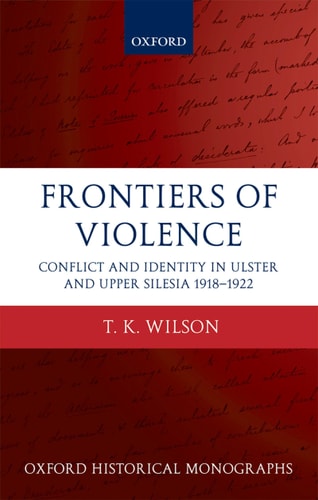
Frontiers of Violence: Conflict and Identity in Ulster and Upper Silesia, 1918-1922
0
0
As an Amazon Associate and affiliate partner, Menrva Books earns from qualifying purchases. Learn more
Author Description
In the years after the First World War both Ulster and Upper Silesia saw violent conflicts over self-determination. The violence in Upper Silesia was more intense both in the numbers killed and in the forms it took. Acts of violation such as rape or mutilation were noticeably more common in Upper Silesia than in Ulster.Examining the nature of communal boundaries, Timothy Wilson explains the profound contrasts in these experiences of plebeian violence. In Ulster the rival communities were divided by religion, but shared a common language. In Upper Silesia, the rival sides were united in religion-92 per cent of the local population being Catholic-but ostensibly divided on linguistic grounds between German and Polish speakers. In practice, language in Upper Silesia proved a far more porous boundary than did religion in Ulster. Language could not always be taken as a straightforward indication of national loyalties.At a local level, boundaries mattered because without them there could not be any sense of security. In Ulster, where communal identities were already clearly staked out, militants tended to concentrate on the limited task of boundary maintenance. In Upper Silesia, where national identities were so unclear, they focused upon boundary creation. This was a task that required more "transgressive" violence. Hence atrocity was more widely practised in Upper Silesia because it could, and did, act as a polarizing force.
Menrva's Summary
THE THESIS
This work investigates why post-WWI conflicts in Ulster and Upper Silesia manifested with such starkly different levels and types of violence despite both regions facing similar struggles for self-determination. Timothy Wilson, a historian specializing in modern European conflict, utilizes a comparative framework to analyze how communal boundaries—defined by religion in Ulster and language in Upper Silesia—dictated the nature of local violence. By examining the social and political mechanics of these two regions, Wilson argues that the clarity of pre-existing identities directly influenced the intensity and transgressive nature of the violence employed by militants.
THE SCOPE MAP
What You Will Find
- Comparative analysis of communal violence in Ulster and Upper Silesia between 1918 and 1922.
- Examination of how religious versus linguistic identity markers function as social boundaries.
- Analysis of the relationship between identity ambiguity and the use of transgressive violence like mutilation and rape.
- Historical assessment of how boundary maintenance differs from boundary creation in conflict zones.
THE AUTHORITY PERSPECTIVE
Experts recognize this monograph as a rigorous contribution to the comparative study of ethnic and nationalistic violence. Readers frequently note the academic density of the prose and the precision with which Wilson navigates the complex social landscapes of early twentieth-century Europe.
Page Count:
288
Publication Date:
2010-08-13
Publisher:
Oxford University Press
ISBN-10:
0199583714
ISBN-13:
9780199583713
History
Ireland
Poland
Czech Republic
Silesia
Conflict Studies
Sociology
Violence
European History
Northern Ireland
Community Tags
Similar Books