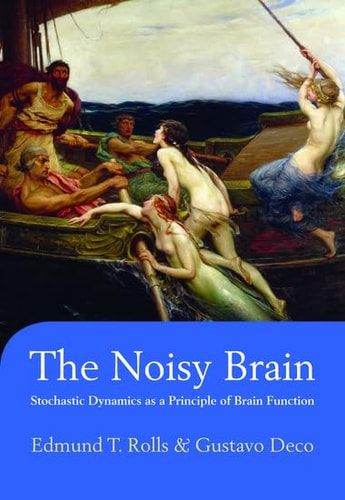
The Noisy Brain: Stochastic Dynamics as a Principle of Brain Function
0
0
As an Amazon Associate and affiliate partner, Menrva Books earns from qualifying purchases. Learn more
Author Description
The activity of neurons in the brain is noisy in that their firing times are random when they are firing at a given rate. This introduces a random or stochastic property into brain processing which we show in this book is fundamental to understanding many aspects of brain function, including probabilistic decision making, perception, memory recall, short-term memory, attention, and even creativity. We show that in many of these processes, the noise caused by the random neuronal firing times is useful. However, this stochastic dynamics can be unstable or overstable, and we show that the stability of attractor networks in the brain in the face of noise may help to understand some important dysfunctions that occur in schizophrenia, normal aging, and obsessive-compulsive disorder.The book provides a unifying computational approach to brain function which links synaptic and biophysical properties of neurons through the firing of single neurons to the properties of the noise in large connected networks of noisy neurons to the levels of functional neuroimaging and behaviour. Integrate-and-fire neuronal attractor networks with noise, complementary mean-field analyses using approaches from theoretical physics, and how they can be used to understand neuronal, functional neuroimaging, and behavioural mechanisms data on decision making, perception, memory recall, short-term memory, attention and brain dysfunctions that occur in schizophrenia, normal aging, and obsessive-compulsive disorder, are described.'The Noisy Brain' will be valuable for those in the fields of neuroscience, psychology, cognitive neuroscience, and biology from advanced undergraduate level upwards. It will also be of interest to those interested in neuroeconomics, animal behaviour, zoology, psychiatry, medicine, physics, and philosophy. The book has been written with modular chapters and sections, making it possible to select particular Chapters for course work. Advanced material on the physics of stochastic dynamics in the brain is contained in the Appendix.
Menrva's Summary
THE THESIS
This book investigates how the stochastic, or random, nature of neuronal firing serves as a fundamental principle underlying complex brain functions and cognitive processes. Authors Edmund T. Rolls and Gustavo Deco, both established researchers in computational neuroscience, present a unified framework that bridges biophysical properties of neurons with large-scale network dynamics. By utilizing integrate-and-fire attractor models and mean-field analyses, the authors argue that neural noise is not merely a byproduct but a functional component of decision-making, memory, and attention, while also providing a basis for understanding specific neurological and psychiatric disorders.
THE SCOPE MAP
What You Will Find
- Computational models of integrate-and-fire neuronal attractor networks.
- Theoretical physics approaches applied to mean-field analysis of neural noise.
- Clinical correlations between stochastic dynamics and conditions such as schizophrenia, obsessive-compulsive disorder, and aging.
- Integrative frameworks linking single-neuron activity to functional neuroimaging and behavioral data.
THE AUTHORITY PERSPECTIVE
Experts recognize this work as a rigorous, technical examination of computational neuroscience that successfully bridges the gap between microscopic synaptic activity and macroscopic behavior. Readers frequently note the academic density of the prose, which is intended for advanced students and researchers in biology, psychology, and physics.
Page Count:
314
Publication Date:
2010-03-26
Publisher:
Oxford University Press
ISBN-10:
0199587868
ISBN-13:
9780199587865
Psychology
Neuroscience
Physics
Neurons
Localization Of Functions
Community Tags
Similar Books
Reader Comments
Share Your Thoughts
No comments yet. Be the first to share your thoughts!