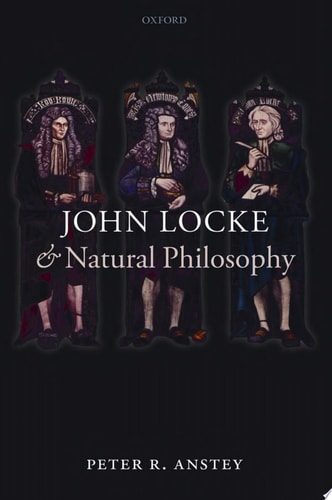
John Locke and Natural Philosophy
0
0
As an Amazon Associate and affiliate partner, Menrva Books earns from qualifying purchases. Learn more
Author Description
Peter Anstey presents a thorough and innovative study of John Locke's views on the method and content of natural philosophy. Focusing on Locke's Essay concerning Human Understanding, but also drawing extensively from his other writings and manuscript remains, Anstey argues that Locke was an advocate of the Experimental Philosophy: the new approach to natural philosophy championed by Robert Boyle and the early Royal Society who were opposed to speculative philosophy.On the question of method, Anstey shows how Locke's pessimism about the prospects for a demonstrative science of nature led him, in the Essay, to promote Francis Bacon's method of natural history, and to downplay the value of hypotheses and analogical reasoning in science. But, according to Anstey, Locke never abandoned the ideal of a demonstrative natural philosophy, for he believed that if we could discover the primary qualities of the tiny corpuscles that constitute material bodies, we could then establish a kind of corpuscular metric that would allow us a genuine science of nature. It was only after the publication of the Essay, however, that Locke came to realize that Newton's Principia provided a model for the role of demonstrative reasoning in science based on principles established upon observation, and this led him to make significant revisions to his views in the 1690s.On the content of Locke's natural philosophy, it is argued that even though Locke adhered to the Experimental Philosophy, he was not averse to speculation about the corpuscular nature of matter. Anstey takes us into new terrain and new interpretations of Locke's thought in his explorations of his mercurialist transmutational chymistry, his theory of generation by seminal principles, and his conventionalism about species.
Menrva's Summary
THE THESIS
This book investigates the extent to which John Locke’s philosophical framework was shaped by and contributed to the development of seventeenth-century natural philosophy. Peter R. Anstey, a scholar of early modern philosophy, utilizes a rigorous analysis of Locke’s Essay concerning Human Understanding alongside his private manuscripts and correspondence. The author argues that Locke was a committed proponent of the Experimental Philosophy, positioning him within the intellectual circle of Robert Boyle and the early Royal Society. By examining Locke's evolving views on scientific methodology and corpuscular theory, Anstey demonstrates how Locke navigated the tension between speculative philosophy and empirical observation.
THE SCOPE MAP
What You Will Find
- An analysis of the influence of Robert Boyle and the Royal Society on Locke’s scientific methodology.
- A detailed examination of Locke’s transition from Baconian natural history to the Newtonian model of demonstrative reasoning.
- Exploration of Locke’s specific theories regarding corpuscular matter, chymistry, and the generation of species.
- A synthesis of primary source materials, including published essays and unpublished manuscript remains.
THE AUTHORITY PERSPECTIVE
Scholars recognize this work as a significant contribution to the study of Locke’s intellectual development, particularly regarding his engagement with the scientific revolution. Readers frequently note the academic density of the prose, which serves as a foundational text for those interested in the intersection of early modern philosophy and the history of science.
Page Count:
272
Publication Date:
2011-05-19
Publisher:
Oxford University Press
ISBN-10:
0199589771
ISBN-13:
9780199589777
Philosophy
Non-Fiction
Epistemology
Community Tags
Other Editions(3)


Similar Books

Reader Comments
Share Your Thoughts
No comments yet. Be the first to share your thoughts!