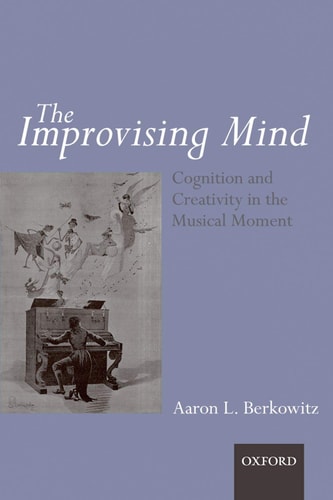
The Improvising Mind: Cognition and Creativity in the Musical Moment
0
0
As an Amazon Associate and affiliate partner, Menrva Books earns from qualifying purchases. Learn more
Author Description
The ability to improvise represents one of the highest levels of musical achievement. An improviser must master a musical language to such a degree as to be able to spontaneously invent stylistically idiomatic compositions on the spot. This feat is one of the pinnacles of human creativity, and yet its cognitive basis is poorly understood. What musical knowledge is required for improvisation? How does a musician learn to improvise? What are the neural correlates of improvised performance?In The Improvising Mind, these questions are explored through an interdisciplinary approach that draws on cognitive neuroscience, study of historical pedagogical treatises on improvisation, interviews with improvisers, and musical analysis of improvised performances. Findings from these treatises and interviews are discussed from the perspective of cognitive psychological theories of learning, memory, and expertise. Musical improvisation has often been compared to 'speaking a musical language.' While past research has focussed on comparisons of music and language perception, few have dealt with this comparison in the performance domain. In this book, learning to improvise is compared with language acquisition, and improvised performance is compared with spontaneous speech from both theoretical and neurobiological perspectives.Tackling a topic that has hitherto received little attention, The Improvising Mind will be a valuable addition to the literature in music cognition. This is a book that will make fascinating reading for musicologists, music theorists, cognitive neuroscientists and psychologists, musicians, music educators, and anyone with an interest in creativity.
Menrva's Summary
THE THESIS
How does the human brain facilitate the complex, spontaneous act of musical improvisation? Aaron Berkowitz, a researcher in music cognition, investigates the intersection of neurobiology, pedagogical history, and cognitive psychology to demystify the mechanisms behind improvised performance. By synthesizing data from interviews with professional improvisers, historical treatises, and current neuroscience, the author constructs a framework that treats improvisation as a sophisticated form of language acquisition and spontaneous speech.
THE SCOPE MAP
What You Will Find
- Comparative analysis between musical improvisation and linguistic acquisition processes.
- Neurobiological correlates of spontaneous musical performance.
- Historical pedagogical methods for teaching and learning improvisation.
- Cognitive psychological theories regarding memory, expertise, and creative output.
THE AUTHORITY PERSPECTIVE
Experts in musicology and cognitive science recognize this work as a significant contribution to a previously under-researched area of performance studies. Readers frequently note the accessible yet rigorous integration of interdisciplinary data, making it a foundational text for those studying the intersection of creativity and brain function.
Page Count:
240
Publication Date:
2010-09-03
Publisher:
Oxford University Press
ISBN-10:
0199590958
ISBN-13:
9780199590957
Psychology
Music
Creativity
Music theory
Neuroscience
Music
Cognition
Community Tags
Similar Books