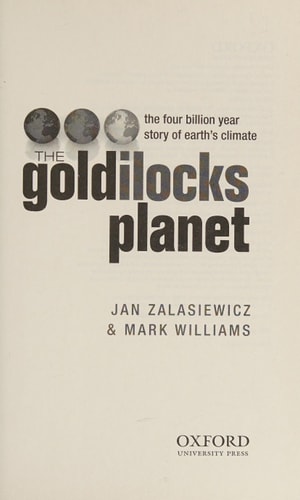
The Goldilocks Planet: The 4 Billion Year Story of Earth's Climate
0
0
As an Amazon Associate and affiliate partner, Menrva Books earns from qualifying purchases. Learn more
Author Description
Climate change is a major topic of concern today and will be so for the foreseeable future, as predicted changes in global temperatures, rainfall, and sea level continue to take place. But as Jan Zalasiewicz and Mark Williams reveal in The Goldilocks Planet, the climatic changes we are experiencing today hardly compare to the changes the Earth has seen over the last 4.5 billion years.Indeed, the vast history that the authors relate here is dramatic and often abrupt--with massive changes in global and regional climate, from bitterly cold to sweltering hot, from arid to humid. They introduce us to the Cryogenian period, the days of Snowball Earth seven hundred million years ago, when ice spread to cover the world, then melted abruptly amid such dramatic climatic turbulence that hurricanes raged across the Earth. We read about the Carboniferous, with tropical jungles at the equator (where Pennsylvania is now) and the Cretaceous Period, when the polar regions saw not ice but dense conifer forests of cypress and redwood, with gingkos and ferns. The authors also show how this history can be read from clues preserved in the Earth's strata. The evidence is abundant, though always incomplete--and often baffling, puzzling, infuriating, tantalizing, seemingly contradictory. Geologists, though, are becoming ever more ingenious at deciphering this evidence, and the story of the Earth's climate is now being reconstructed in ever-greater detail--maybe even providing us with clues to the future of contemporary climate change.And through all of this, the authors conclude, the Earth has remained perfectly habitable--in stark contrast to its planetary neighbors. Not too hot, not too cold; not too dry, not too wet--"the Goldilocks planet."
Menrva's Summary
THE THESIS
How has Earth maintained a habitable climate over four billion years despite extreme environmental fluctuations? Jan Zalasiewicz and Mark B. Williams, both distinguished geologists, utilize the geological record to synthesize a comprehensive history of planetary climate. They argue that Earth's unique ability to remain within a habitable range—the 'Goldilocks' condition—is a result of complex, often violent, feedback loops and geological processes that distinguish it from its neighbors.
THE SCOPE MAP
What You Will Find
- A chronological survey of Earth's climate history spanning 4.5 billion years.
- Detailed analysis of extreme periods including the Cryogenian 'Snowball Earth' and the tropical Cretaceous.
- Methodologies for interpreting paleoclimatic data preserved in sedimentary strata.
- Comparative planetary analysis contrasting Earth's stability with the inhospitable conditions of Venus and Mars.
THE AUTHORITY PERSPECTIVE
Experts and readers alike praise this work for its ability to translate complex geological data into a narrative that provides essential context for modern climate discussions. The prose is noted for its accessibility, making technical paleoclimatic concepts understandable for a general audience while maintaining scientific rigor.
Page Count:
256
Publication Date:
2012-05-18
Publisher:
Oxford University Press
ISBN-10:
0199593574
ISBN-13:
9780199593576
History
Science
Nature
Climatology
Climate Change
Geology
Climatic changes
Earth Science
Environment
Community Tags
Similar Books