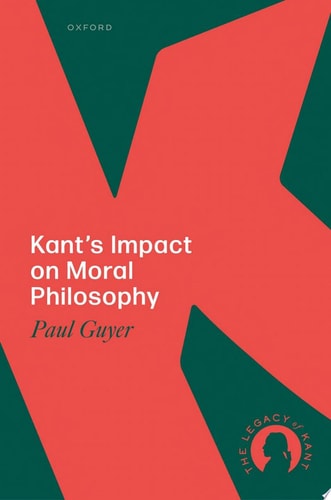
Kant's Impact on Moral Philosophy
0
0
As an Amazon Associate and affiliate partner, Menrva Books earns from qualifying purchases. Learn more
Author Description
Immanuel Kant introduced a new paradigm into modern moral philosophy, first with his Groundwork for the Metaphysics of Morals in 1785, followed by his Critique of Practical Reason in 1788, Religion within the Boundaries of Mere Reason in 1793, and Metaphysics of Morals in 1798. For Kant, the fundamental goal of morality is not the realization of the greatest happiness for the greatest number, under some interpretation of that formula, but the realization of human autonomy governed by pure reason in the form of the "categorical imperative." Kant's ideal of autonomy is nothing less than the greatest possible freedom of each human being to set his or her own ends compatible with the equal freedom of every other human being to do the same. As Kant put it in lectures to his own students, freedom "not restrained under certain rules... is the most terrible thing there could ever be," but the condition "under which alone the greatest use of freedom is possible, and under which it can be self-consistent" is the "essential end of humankind" and the "inner worth of the world."Kant's work immediately drew the attention of both critics and supporters. While some argued that Kant's categorical imperative was an "empty formalism," that he left no room for happiness in his morality, that he could not explain responsibility for evil, and that he allowed no room for moral feeling in morally worthy motivation, others have found inspiration in his underlying idea that maximal but equal freedom is the "inner worth of the world."This book examines the response to Kant by other significant moral philosophers from Fichte, Schelling, and Hegel to through T.H. Green, Josiah Royce, and Friedrich Nietzsche, to John Rawls, Onora O'Neill, Christine Korsgaard, and Derek Parfit, with many stops along the way. The book is not a history of Kant scholarship, but an examination of Kant's impact on other major moral philosophers from his time to our own. While it attempts to do justice to the arguments of every philosopher discussed, the book argues that the most profound responses to Kant have been precisely those that have developed in their own way Kant's ideal of freedom as the inner worth of the world.
Menrva's Summary
THE THESIS
This book investigates the historical trajectory and enduring influence of Immanuel Kant’s moral philosophy on subsequent thinkers from the late eighteenth century to the present day. Paul Guyer, a preeminent Kant scholar, utilizes his extensive expertise to analyze how Kant’s paradigm of autonomy and the categorical imperative shifted the landscape of ethical discourse. By tracing the reception and adaptation of these concepts, the work evaluates how various philosophers have either challenged or integrated Kantian principles into their own systems of thought.
THE SCOPE MAP
What You Will Find
- A chronological examination of Kantian influence spanning from Fichte, Schelling, and Hegel to contemporary figures like John Rawls and Christine Korsgaard.
- An analysis of the tension between Kant’s focus on autonomy and the critiques regarding moral formalism and the role of happiness.
- A comparative study of how diverse philosophers have interpreted the categorical imperative and the concept of human freedom.
- A thematic exploration of the shift from Kant’s original moral framework to modern interpretations of responsibility and moral worth.
THE AUTHORITY PERSPECTIVE
Experts recognize this work as a significant contribution to the history of ideas, noting its ability to synthesize complex philosophical lineages into a coherent narrative. Readers frequently highlight the academic rigor of the prose, which serves as a valuable resource for those seeking to understand the evolution of moral philosophy.
Page Count:
688
Publication Date:
2024-01-01
Publisher:
Oxford University Press
ISBN-10:
0199592454
ISBN-13:
9780199592456
Philosophy
Ethics
Moral Philosophy
Community Tags
Other Editions(2)
Similar Books





Reader Comments
Share Your Thoughts
No comments yet. Be the first to share your thoughts!