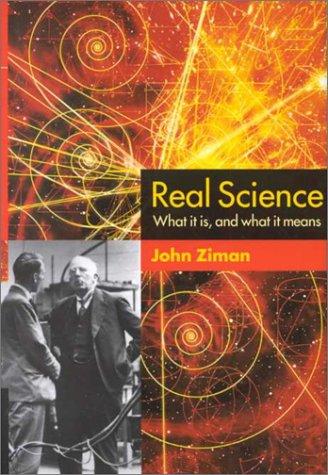
Real Science
0
0
As an Amazon Associate and affiliate partner, Menrva Books earns from qualifying purchases. Learn more
Author Description
Scientists and 'anti-scientists' alike need a more realistic image of science. The traditional mode of research, academic science, is not just a 'method': it is a distinctive culture, whose members win esteem and employment by making public their findings. Fierce competition for credibility is strictly regulated by established practices such as peer review. Highly specialized international communities of independent experts form spontaneously and generate the type of knowledge we call 'scientific' - systematic, theoretical, empirically tested, quantitative, and so on. Ziman shows that these familiar 'philosophical' features of scientific knowledge are inseparable from the ordinary cognitive capabilities and peculiar social relationships of its producers. This wide angled close-up of the natural and human sciences recognizes their unique value, whilst revealing the limits of their rationality, reliability and universal applicability. It also shows how, for better or worse, the new 'post-academic' research culture of teamwork, accountability, etc. is changing these supposedly eternal philosophical characteristics.--Jacket.
Menrva's Summary
THE THESIS
This book argues that scientific knowledge is inseparable from the social culture and cognitive capabilities of its producers. J. M. Ziman, a physicist and science policy advisor, examines the traditional culture of academic science, characterized by public findings, peer review, and spontaneous international communities of experts. He demonstrates how these 'philosophical' features are intrinsically linked to the scientists themselves. The book also explores the limits of scientific rationality and applicability, and analyzes the emerging 'post-academic' research culture of teamwork and accountability, and its impact on science's core characteristics.
THE SCOPE MAP
- Analysis of the traditional culture of academic science and its practices (peer review, competition for credibility).
- Exploration of the social relationships and cognitive capabilities of scientists as producers of knowledge.
- Examination of the 'philosophical' features of scientific knowledge and their connection to its producers.
- Discussion on the limits of scientific rationality, reliability, and universal applicability.
- Investigation into the changing landscape of research with the rise of 'post-academic' culture.
- Comparison of 'academic' and 'post-academic' research environments and their impact on scientific characteristics.
- Consideration of the value of natural and human sciences within their societal context.
THE AUTHORITY PERSPECTIVE
The book is recognized for providing a realistic image of science, bridging the gap between scientists and 'anti-scientists'. It is noted for its comprehensive analysis of scientific culture, detailing how established practices and the social dynamics among researchers shape the very nature of scientific knowledge. The work is also appreciated for its balanced perspective, acknowledging the unique value of science while critically examining its limitations. Furthermore, it offers insights into the evolving nature of scientific research in the face of new collaborative and accountable models.
Page Count:
399
Publication Date:
2000-01-01
ISBN-10:
052177229X
ISBN-13:
9780521772297
Philosophy
Science
Non-Fiction
Sociology of Science
Community Tags
Similar Books