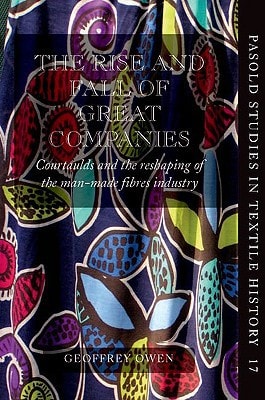
The Rise and Fall of Great Companies: Courtaulds and the Reshaping of the Man-Made Fibres Industry
0
0
As an Amazon Associate and affiliate partner, Menrva Books earns from qualifying purchases. Learn more
Author Description
This book is about a company which pioneered a major new industry, failed to build on that success, and ended up being taken over and broken up. By comparing this firm with its competitors in the same industry, the book sheds light on one of the hardest of all managerial challenges: what companies can do when their industry goes through a period of turbulence, forcing them to change direction, learn new skills, and perhaps abandon businesses on which they have relied for many years.Courtaulds was a British company which was once the world's leading producer of man-made fibres. It failed to adapt to the crisis in that industry that began in the mid-1970s, and lost ground to the point where, 25 years later, it could no longer sustain itself as an independent company. The crisis stemmed from the shift of textiles, clothing, and man-fibre production to low-wage countries, and above all to China.The book looks in some detail at the other companies - European, American, and Japanese - which had a big commitment to man-made fibres in the earlier post-war decades and, like Courtaulds, faced difficult adjustment problems in the closing years of the 20th century. Why did some of them handle the crisis better than Courtaulds? In answering this question the book looks both at decisions taken by individual managers and at the national context in which they were operating. Institutional differences between countries, notably in the role of shareholders and the financial markets, played an important role in determining which companies survived and which did not.
Menrva's Summary
THE THESIS
This book investigates the strategic failures and managerial challenges that led to the decline and eventual dissolution of the British industrial giant, Courtaulds. Geoffrey Owen, a former editor of the Financial Times, utilizes his extensive background in industrial policy to analyze the company's trajectory within the global man-made fibres market. By contrasting Courtaulds with international competitors, the author argues that institutional frameworks, national financial systems, and specific managerial decisions were the primary determinants of corporate survival during the industry's late 20th-century turbulence.
THE SCOPE MAP
What You Will Find
- A detailed historical analysis of the man-made fibres industry from the post-war era through the late 1990s.
- Comparative case studies of European, American, and Japanese firms facing similar market shifts.
- An examination of the impact of globalization and the migration of textile production to low-wage economies.
- An assessment of how national institutional differences, such as shareholder roles and financial market structures, influenced corporate longevity.
THE AUTHORITY PERSPECTIVE
Experts recognize this work as a rigorous contribution to business history that provides a clear-eyed look at the complexities of industrial decline. Readers frequently note the academic density of the prose, which serves as a foundational text for those studying corporate strategy and the evolution of global manufacturing.
Page Count:
338
Publication Date:
2010-10-28
Publisher:
OUP/Pasold Research Fund
ISBN-10:
0199592896
ISBN-13:
9780199592890
History
Economics
Business
Textile industry
Industrial history
Great Britain
Management
Community Tags
Similar Books