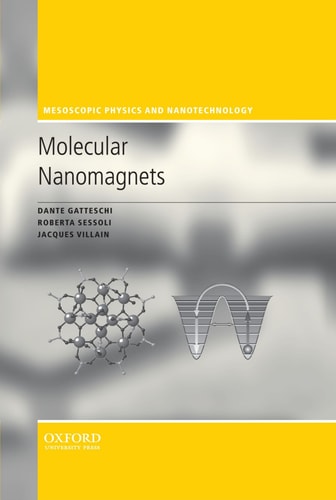
Molecular Nanomagnets
0
0
As an Amazon Associate and affiliate partner, Menrva Books earns from qualifying purchases. Learn more
Author Description
Nanomagnetism is a rapidly expanding area of research which appears to be able to provide novel applications. Magnetic molecules are at the very bottom of the possible size of nanomagnets and they provide a unique opportunity to observe the coexistence of classical and quantum properties. The discovery in the early 90's that a cluster comprising twelve manganese ions shows hysteresis of molecular origin, and later proved evidence of quantum effects, opened a new research area which is still flourishing through the collaboration of chemists and physicists. This book is the first attempt to cover in detail the new area of molecular nanomagnetism, for which no other book is available. In fact research and review articles, and book chapters are the only tools available for newcomers and the experts in the field. It is written by the chemists originators and by a theorist who has been one of the protagonists of the development of the field, and is explicitly addressed to an audience of chemists and physicists, aiming to use a language suitable for the two communities.
Menrva's Summary
THE THESIS
This text investigates the fundamental physical and chemical properties of molecular nanomagnets, specifically focusing on the intersection of classical and quantum behaviors at the nanoscale. The authors, who are pioneers in the field of molecular magnetism, synthesize decades of research to provide a comprehensive framework for understanding how clusters of metal ions exhibit magnetic hysteresis. By bridging the gap between chemical synthesis and theoretical physics, the book establishes a foundational understanding of how these molecular systems function as the smallest possible magnets.
THE SCOPE MAP
What You Will Find
- Detailed analysis of manganese ion clusters and their magnetic hysteresis properties.
- Theoretical models explaining the coexistence of classical and quantum magnetic phenomena.
- Collaborative methodologies for chemists and physicists working in nanomagnetism.
- Historical overview of the development of molecular nanomagnetism since the early 1990s.
THE AUTHORITY PERSPECTIVE
Experts recognize this work as the foundational text for the field of molecular nanomagnetism, effectively bridging the gap between chemical synthesis and physical theory. Readers frequently note the technical density of the prose, which is intended for an audience of advanced researchers and graduate students in the physical sciences.
Page Count:
395
Publication Date:
2011-06-04
Publisher:
Oxford University Press
ISBN-10:
0199602263
ISBN-13:
9780199602261
Science
Magnetism
Nanotechnology
Physics
Chemistry
Community Tags
Other Editions(3)
Similar Books