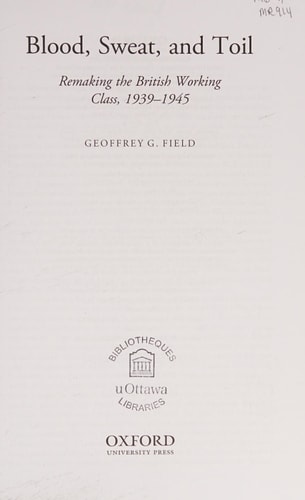
Blood, Sweat, and Toil: Remaking the British Working Class, 1939-1945
0
0
As an Amazon Associate and affiliate partner, Menrva Books earns from qualifying purchases. Learn more
Author Description
Blood, Sweat, and Toil is the first scholarly history of the British working class in the Second World War. It integrates social, political, and labour history, and reflects the most recent scholarship and debates on social class, gender, and the forging of identities.Geoffrey Field examines the war's impact on workers in the varied contexts of the family, military service, the workplace, local communities, and the nation. Extensively researched, using official documents, diaries and letters, the records of trade unions and numerous other institutions, Blood, Sweat, and Toil traces the rapid growth of trade unionism, joint consultation, and strike actions in the war years. It also analyses the mobilization of women into factories and the uniformed services and the lives of men conscripted into the army, showing how these experiences shaped their aspirations and their social and political attitudes.Previous studies of the Home Front have analysed the lives of civilians, but they have neglected the importance of social class in defining popular experience and its centrality in public attitudes, official policy, and the politics of the war years. Contrary to accounts that view the war as eroding class divisions and creating a new sense of social unity in Britain, Field argues that the 1940s was a crucial decade in which the deeply fragmented working class of the interwar decades was 'remade', achieving new collective status, power, and solidarity. Employing a contingent, non-teleological conception of class identity and indicating the plural and shifting mix of factors that contributed to workers' social consciousness, he criticizes recent revisionist scholarship that has downplayed the significance of class in British society.
Menrva's Summary
THE THESIS
This work investigates how the British working class was fundamentally reshaped and consolidated during the Second World War, challenging the notion that the conflict merely fostered a monolithic sense of national unity. Geoffrey G. Field, a historian specializing in modern British social history, utilizes a vast array of primary sources—including official government documents, personal diaries, letters, and trade union records—to construct his argument. He posits that the 1940s served as a transformative period where fragmented labor groups achieved a new level of collective power and social identity, directly countering revisionist claims that class significance declined during the war years.
THE SCOPE MAP
What You Will Find
- An analysis of the British Home Front between 1939 and 1945 focusing on labor and social dynamics.
- Examination of the mobilization of women into factories and military service alongside the experiences of conscripted men.
- A detailed study of the growth of trade unionism, joint consultation, and industrial strike actions.
- A critical evaluation of how class identity was constructed and contested within family, community, and national contexts.
THE AUTHORITY PERSPECTIVE
Scholars recognize this text as a foundational contribution to the social history of the British Home Front, particularly for its rigorous integration of class analysis into wartime studies. Readers frequently note the academic density of the prose and the author's meticulous use of archival evidence to support his arguments regarding social stratification.
Page Count:
496
Publication Date:
2012-01-13
Publisher:
Oxford University Press
ISBN-10:
0199604118
ISBN-13:
9780199604111
History
Sociology
Consciousness
Labor history
Social Classes
Social History
British History
Working class
Community Tags
Similar Books