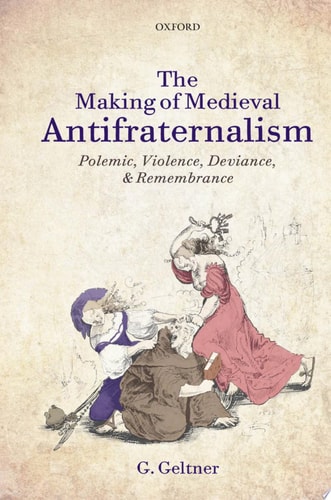
The Making of Medieval Antifraternalism: Polemic, Violence, Deviance, and Remembrance
0
0
As an Amazon Associate and affiliate partner, Menrva Books earns from qualifying purchases. Learn more
Author Description
The mendicant orders-Augustinians, Carmelites, Dominicans, Franciscans, and several other groups-spread across Europe apace from the early thirteenth century, profoundly influencing numerous aspect of medieval life. But alongside their tremendous success, their members (friars) also encountered derision, scorn, and even violence. Such opposition, generally known as antifraternalism, is often seen as an ecclesiastical in-house affair or an ideological response to the brethren's laxity: both cases registering a moral decline symptomatic of a decadent church. Challenging the accuracy of these views, Geltner contends that the phenomenon exhibits a breadth of scope that on the one hand pushes it far beyond its accustomed boundaries, and on the other supports only tenuous links with Reformation or modern forms of anticlericalism.Drawing from numerous sources, from theological treatises to poetry and criminal court records, Guy Geltner shows that people from all walks of life lambasted and occasionally assaulted the brethren, orchestrating detailed scenes of urban violence in the process. Their myriad motivations and diverse goals preclude us from associating antifraternalism with any one ideology or agenda, let alone allow us to brand many of its proponents as religious reformers. At the same time, he demonstrates the friars' active role in forging a medieval antifraternal tradition, not only by deviating from their founders' paths to varying degrees, but also by chronicling their suffering inter fideles and thus incorporating it into the orders' identity as the vanguard of Christianity. In doing so, Geltner illuminates a major chapter in Europe's social, urban, and religious history.
Menrva's Summary
THE THESIS
This book investigates the origins and multifaceted nature of medieval antifraternalism, challenging the traditional view that opposition to mendicant orders was merely a symptom of ecclesiastical moral decline. G. Geltner, a scholar of medieval social and religious history, utilizes a broad array of primary sources to argue that antifraternalism was a complex social phenomenon rather than a singular ideological movement. By examining the interactions between friars and the public, the author demonstrates that this opposition was deeply embedded in the urban, social, and religious fabric of the period.
THE SCOPE MAP
What You Will Find
- Analysis of diverse primary sources including theological treatises, vernacular poetry, and criminal court records.
- Examination of urban violence and public confrontations involving mendicant orders across medieval Europe.
- Investigation into how the friars themselves contributed to the antifraternal tradition through their own internal identity formation.
- A critical reassessment of the links between medieval antifraternalism and later Reformation-era anticlericalism.
THE AUTHORITY PERSPECTIVE
Historians and scholars of the medieval period frequently cite this work for its rigorous use of archival evidence and its departure from traditional ecclesiastical narratives. The text is recognized as a significant contribution to the study of social conflict and religious identity in the Middle Ages.
Page Count:
208
Publication Date:
2012-05-18
Publisher:
Oxford University Press
ISBN-10:
0199639450
ISBN-13:
9780199639458
History
Religious History
Public opinion
European History
Social History
Europe
Friars
Community Tags
Similar Books