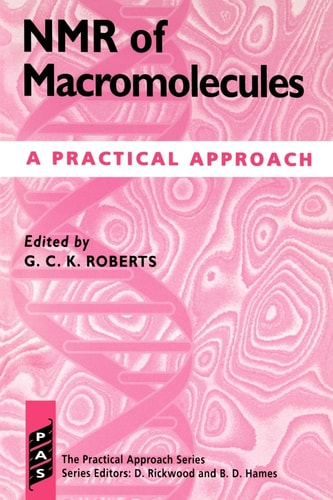
NMR of Macromolecules: A Practical Approach
0
0
As an Amazon Associate and affiliate partner, Menrva Books earns from qualifying purchases. Learn more
Author Description
The last 10-15 years have seen an enormous upsurge in the use of nuclear magnetic resonance (NMR) to study the conformation and interactions of biological macromolecules. NMR is now second in importance only to x-ray crystallography in structural molecular biology. As a result, more and more biologists are seeking to use NMR to solve their structural problems. There are several very good books which give an introduction to the theory of modern NMR spectroscopy, but much less is available on the practical side which is specifically tailored to the special technique required.The aim of this book is to provide the newcomer to these applications of NMR, whether a graduate student or a more senior biologist who wishes to apply NMR to his or her favourite protein, with practical guidance on how to choose the right experiment to obtain the desired information, how to carry out the experiment, and how to analyse the resulting spectra. Those who are familiar with chemical applications of NMR but not those to biological macromolecules will also find this book helpful in describing the special requirements of NMR studies of these large molecules. One of the consequences of the considerable proliferation of papers describing the application of NMR to biological macromolecules has been the increasing reluctance of journals to provide space for a detailed description of the methods involved in, for example, resonance assignment or the analysis of NOEs for structure determination. This book will fill this gap, so as to allow the reader both to understand what is involved in the experiments described in the literature and to embark on the application of these powerful methods to his or her own system.
Menrva's Summary
THE THESIS
This text addresses the critical need for practical, hands-on guidance for researchers applying nuclear magnetic resonance (NMR) spectroscopy to the study of biological macromolecules. Gordon C. K. Roberts, a specialist in the field, compiles methodologies to bridge the gap between theoretical NMR knowledge and the specific technical requirements of structural biology. The book serves as a manual for graduate students and established biologists, providing a framework for selecting appropriate experiments, executing data collection, and interpreting complex spectral results for large molecules.
THE SCOPE MAP
What You Will Find
- Methodologies for resonance assignment in biological macromolecules
- Techniques for the analysis of nuclear Overhauser effects (NOEs) for structure determination
- Practical guidance on experiment selection tailored to specific structural problems
- Protocols for analyzing and interpreting resulting NMR spectra
THE AUTHORITY PERSPECTIVE
Experts recognize this volume as a foundational resource for those transitioning from general chemical NMR to the specialized requirements of structural molecular biology. Readers frequently note the clarity of the procedural instructions, which serve to supplement the limited methodological detail often found in contemporary scientific journals.
Page Count:
428
Publication Date:
1993-09-23
Publisher:
Oxford University Press
ISBN-10:
0199632251
ISBN-13:
9780199632251
Science
Macromolecules
Biology
Spectroscopy
Chemistry
Reference