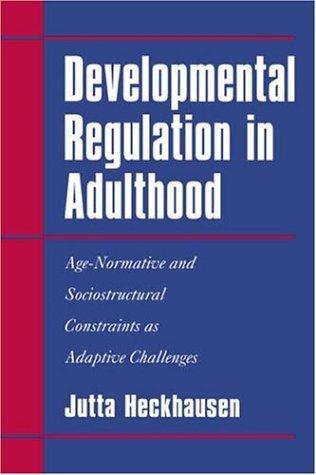
Developmental Regulation in Adulthood
0
0
As an Amazon Associate and affiliate partner, Menrva Books earns from qualifying purchases. Learn more
Author Description
The life-span theory of control proposes that control of one's environment is the key to adaptive functioning throughout the life span. The theory identifies the evolutionary roots and the life-span developmental course of human striving to control the environment (primary control) and the self (secondary control). Primary control is directed at producing effects in the external world, while secondary control influences the internal world so as to optimize the motivational resources for primary control. A series of studies illustrate the rich repertoire of the human control system that exists to master developmental challenges in various age periods and developmental ecologies.
Menrva's Summary
THE THESIS
The life-span theory of control posits that the ability to exert control over one's environment is fundamental to adaptive functioning across all ages. This theory traces the evolutionary origins and developmental trajectory of human efforts to influence the external world (primary control) and the internal self (secondary control) to optimize motivational resources. The book presents a range of studies demonstrating the sophisticated mechanisms of the human control system, designed to navigate developmental challenges across diverse life stages and ecological contexts.
THE SCOPE MAP
- The life-span theory of control and its evolutionary roots.
- The distinction and interplay between primary and secondary control.
- Empirical studies illustrating the human control system's repertoire.
- Adaptation and mastery of developmental challenges throughout adulthood.
- The role of control in various age periods and developmental ecologies.
THE AUTHORITY PERSPECTIVE
This work is likely to be regarded as a significant contribution to the field of developmental psychology, particularly for its comprehensive exploration of control theories across the lifespan. The detailed presentation of empirical studies suggests a text aimed at researchers and advanced students in psychology and related disciplines. Its focus on adaptive functioning and developmental challenges positions it as a key resource for understanding adult development.
Page Count:
262
Publication Date:
2006-01-01
ISBN-10:
0521027136
ISBN-13:
9780521027137
Psychology
Non-Fiction
Developmental Psychology
Community Tags
Similar Books