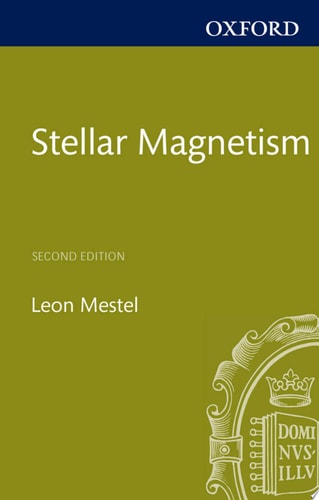
Stellar Magnetism
0
0
As an Amazon Associate and affiliate partner, Menrva Books earns from qualifying purchases. Learn more
Author Description
Ongoing studies in mathematical depth, and inferences from `helioseismological' observations of the internal solar rotation have shown up the limitations in our knowledge of the solar interior and of our understanding of the solar dynamo, manifested in particular by the sunspot cycle, the Maunder minimum, and solar flares. This second edition retains the identical overall structure as the first edition, but is designed so as to be self-contained with the early chapters presenting the basic physics and mathematics underlying cosmical magnetohydrodynamics, followed by studies of the specific applications appropriate for a book devoted to a central area in astrophysics.New to this edition:Chapter 6 gives an account of the present state of dynamo theory in general, and Chapter 8 the applications to the Sun and to other `Late-Type' stars with differing rotation rates -- the `Solar-Stellar Connection'. The minority of the more massive `Early-Type' stars that are observably magnetic are well described by the`oblique rotator' model, with a quasi-steady, `fossil' magnetic structure `frozen' into the highly conducting, non-turbulent envelope. Chapter 9 deals with the considerable progress on the associated theoretical problems.Chapter 7 contains new material, relevant to both Late- and Early-Type Main Sequence stars, to the evolved Red Giants, and also to contracting pre-Main Sequence stars (Chapter 10}, which show the highest degree of magnetic activity (the magneto-rotational instability, and the magneto-centrifugal winds emitted by the surrounding `accretion disk'). In the earlier phases of star formation in molecular clouds (Chapters 11-12), `magneto-turbulence' is emerging as the appropriate scenario for the prediction of the mass spectrum of proto-stars, and the associated formation of planetary satellites. Chapter 14 describes developments in the study of the magnetosphere of a `pulsar' -- a magnetized neutron star -- consisting of spontaneously generated electron-positron pairs.
Menrva's Summary
THE THESIS
This text investigates the fundamental role of magnetic fields in the evolution, structure, and activity of stars across various stages of their life cycles. Leon Mestel, a prominent astrophysicist, synthesizes complex mathematical models and observational data to explain the mechanisms of cosmical magnetohydrodynamics. The book provides a rigorous framework for understanding how magnetic structures influence stellar rotation, dynamo theory, and the behavior of both early-type and late-type stars.
THE SCOPE MAP
What You Will Find
- Comprehensive analysis of dynamo theory and its application to solar and stellar rotation cycles.
- Theoretical models for magnetic structures in massive stars, including the oblique rotator and fossil field concepts.
- Examination of magneto-rotational instability and centrifugal winds in pre-main sequence stars and accretion disks.
- Detailed study of magnetospheric dynamics in pulsars and neutron stars.
THE AUTHORITY PERSPECTIVE
Experts recognize this monograph as a foundational reference for researchers and graduate students specializing in stellar astrophysics. Readers frequently note the high level of mathematical density and the rigorous physical derivations required to fully grasp the presented theories.
Page Count:
754
Publication Date:
2012-05-04
Publisher:
Oxford University Press
ISBN-10:
0199641749
ISBN-13:
9780199641741
Science
Astronomy
Stars
Physics
Astrophysics
Community Tags
Other Editions(6)


Similar Books






Reader Comments
Share Your Thoughts
No comments yet. Be the first to share your thoughts!