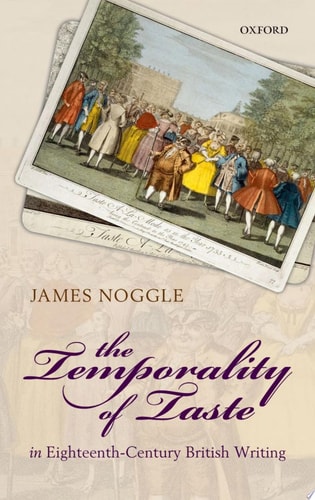
The Temporality of Taste in Eighteenth-Century British Writing
0
0
As an Amazon Associate and affiliate partner, Menrva Books earns from qualifying purchases. Learn more
Author Description
Is taste a quick, momentary experience in the individual mind? Or something durable, shaped by slow, historical processes, affecting groups of people at different times and places? British writers in the eighteenth century believed that it was both, and the tension between these temporal poles shaped the meaning of taste in the period and set a course for aesthetics in following centuries. Focusing on works in many genres--Alexander Pope's poems, David Hume's historiography, essays by Hannah More and Anna Barbauld, and novels by Frances Burney and William Beckford--this book sees the divided temporality of taste as an unpredictable force in British writing. The eighteenth century was the age of taste. Writers considered its intense effects on individual minds as especially characteristic of the collective present of British modernity, whilst they also recognized the disturbing tendency of taste's immediacy and its historical roles to interrupt and foreclose on each other. While noting how taste's two temporal flavors may be made to agree in order to consolidate various national, social, and gendered identities, this book also demonstrates that taste's dual temporality makes it more disruptive than scholars usually think. As such, taste models a kind of critical practice that this book itself endeavours to inherit: the insistent testing of the moment of discernment and on-going patterns of thinking and feeling against each other.
Menrva's Summary
THE THESIS
This book investigates the inherent tension between the immediate, subjective experience of taste and its long-term, historical development within eighteenth-century British literature. James Noggle, a scholar of eighteenth-century studies, examines how writers of the period navigated the conflict between taste as a fleeting individual sensation and taste as a durable, collective cultural force. By analyzing a diverse range of texts, Noggle argues that this dual temporality functioned as a disruptive, unpredictable element that shaped the trajectory of modern aesthetics.
THE SCOPE MAP
What You Will Find
- Analysis of works by Alexander Pope, David Hume, Hannah More, Anna Barbauld, Frances Burney, and William Beckford.
- Examination of the intersection between aesthetic discernment and historical consciousness.
- Investigation into how taste was utilized to construct national, social, and gendered identities.
- A critical framework for understanding the interplay between momentary perception and ongoing patterns of thought.
THE AUTHORITY PERSPECTIVE
Scholars recognize this work as a significant contribution to the study of eighteenth-century aesthetics and the history of ideas. Readers frequently note the academic density of the prose and the precision with which Noggle connects individual literary examples to broader philosophical shifts.
Page Count:
280
Publication Date:
2012-04-07
Publisher:
Oxford University Press
ISBN-10:
0199642435
ISBN-13:
9780199642434
History
British literature
Literary Criticism
Eighteenth Century
Aesthetics
Community Tags
Similar Books