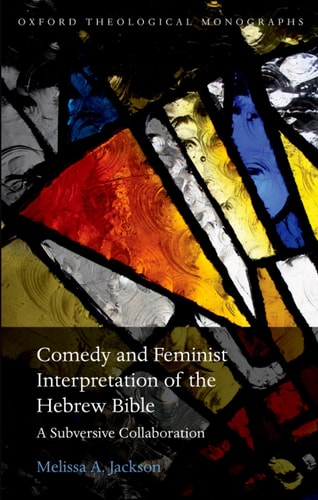
Comedy and Feminist Interpretation of the Hebrew Bible: A Subversive Collaboration
0
0
As an Amazon Associate and affiliate partner, Menrva Books earns from qualifying purchases. Learn more
Author Description
Comedy is both relative, linked to a time and culture, and universal, found pervasively across time and culture. The Hebrew Bible contains comedy of this relative, yet universal nature. Melissa A. Jackson engages the Hebrew Bible via a comic reading and brings that reading into conversation with feminist-critical interpretation, in resistance to any lingering stereotype that comedy is fundamentally non-serious or that feminist critique is fundamentally unsmiling.Dividing comic elements into categories of literary devices, psychological/social features, and psychological/social function, Jackson examines the narratives of a number of biblical characters for evidence of these comic elements. The characters include the trickster matriarchs, the women involved in the infancy of Moses, Rahab, Deborah and Jael, Delilah, three of David's wives (Michal, Abigail, Bathsheba), Jezebel, Ruth, and Esther. Nine particularly instructive points of contact between comedy and feminist interpretation emerge: both (1) resist definition, (2) exist amidst a self/other, subject/object dichotomy, (3) emphasise and utilise context, (4) promote creativity, (5) acknowledge the concept of distancing, (6) work towards revelation, (7) are subversive, (8) are concerned with containment and control, and (9) enable survival. The use of comedy as an interpretive lens for the Hebrew Bible is not without difficulties for feminist interpretation. While maintaining an uncomfortable, even painful, awareness of the hold patriarchy retains on the Hebrew Bible, feminist critics can still choose to allow comedy's revelatory, subversive, survivalist nature to do its work revealing, subverting, and surviving.
Menrva's Summary
THE THESIS
This work investigates the intersection of comic theory and feminist hermeneutics to determine how humor functions as a subversive tool within the narratives of the Hebrew Bible. Melissa A. Jackson, a scholar in biblical studies, utilizes a multidisciplinary framework that categorizes comic elements into literary, psychological, and social dimensions. By applying this lens to various female figures in the text, she argues that comedy and feminist critique share a common capacity for resistance, revelation, and survival against patriarchal structures.
THE SCOPE MAP
What You Will Find
- A classification system for comic elements including literary devices and social functions.
- Detailed analysis of biblical figures such as the trickster matriarchs, Rahab, Deborah, Jael, and Esther.
- A comparative framework identifying nine points of contact between comic theory and feminist interpretation.
- An examination of the tension between patriarchal biblical contexts and the subversive potential of humor.
THE AUTHORITY PERSPECTIVE
Scholars recognize this monograph as a significant contribution to the field of biblical hermeneutics for its innovative synthesis of humor theory and gender studies. Readers frequently note the academic density of the prose, which serves as a rigorous resource for those interested in the intersection of theology and literary criticism.
Page Count:
288
Publication Date:
2012-09-29
Publisher:
Oxford University Press
ISBN-10:
0199656770
ISBN-13:
9780199656776
Religion
Bible
Feminist Theory
Literary Criticism
Theology
Community Tags
Similar Books