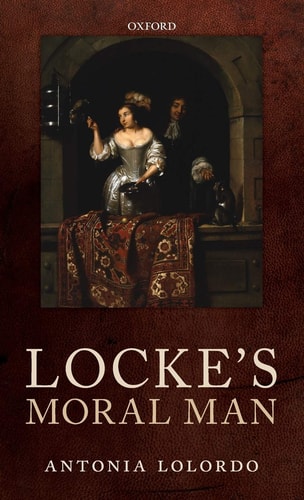
Locke's Moral Man
0
0
As an Amazon Associate and affiliate partner, Menrva Books earns from qualifying purchases. Learn more
Author Description
Antonia Lolordo presents an original interpretation of John Locke's conception of moral agency--one that has implications both for his metaphysics and for the foundations of his political theory. Locke denies that species boundaries exist independently of human convention, holds that the human mind may be either an immaterial substance or a material one to which God has superadded the power of thought, and insists that animals possess the ability to perceive, will, and even reason--indeed, in some cases to reason better than humans. Thus, he eliminates any sharp distinction between humans and the rest of the animal kingdom. However, in his ethical and political work Locke assumes that there is a sharp distinction between moral agents and other beings. He thus needs to be able to delineate the set of moral agents precisely, without relying on the sort of metaphysical and physical facts his predecessors appealed to. Lolordo argues that for Locke, to be a moral agent is simply to be free, rational, and a person. Interpreting the Lockean metaphysics of moral agency in this way helps us to understand both Locke's over-arching philosophical project and the details of his accounts of liberty, personhood, and rationality.
Menrva's Summary
THE THESIS
This book investigates how John Locke defines moral agency in the absence of traditional metaphysical or biological boundaries between humans and animals. Antonia LoLordo, a scholar of early modern philosophy, examines the tension between Locke's rejection of species-based distinctions and his reliance on a clear divide between moral agents and other beings. She argues that Locke identifies moral agency through the specific criteria of freedom, rationality, and personhood, providing a framework that reconciles his metaphysics with his political theory.
THE SCOPE MAP
What You Will Find
- An analysis of Locke's views on immaterial versus material substance and the power of thought.
- A detailed examination of Locke's criteria for moral agency: freedom, rationality, and personhood.
- A critical look at the intersection of Locke's metaphysical claims and his political philosophy.
- An exploration of how Locke differentiates moral agents from the rest of the animal kingdom without relying on traditional biological species boundaries.
THE AUTHORITY PERSPECTIVE
Scholars recognize this work as a significant contribution to the study of Lockean philosophy, particularly for its focus on the consistency of his ethical and metaphysical systems. Readers frequently note the academic density of the prose, which is intended for students and researchers of early modern political thought.
Page Count:
160
Publication Date:
2012-11-17
Publisher:
Oxford University Press
ISBN-10:
0199652775
ISBN-13:
9780199652778
Philosophy
Political Philosophy
Ethics
Metaphysics
Community Tags
Other Editions(2)
Similar Books