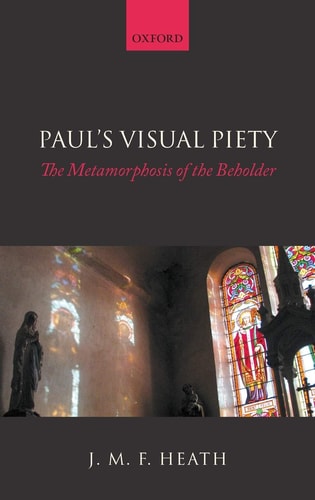
Paul's Visual Piety: The Metamorphosis of the Beholder
0
0
As an Amazon Associate and affiliate partner, Menrva Books earns from qualifying purchases. Learn more
Author Description
This book is at the interface between Visual Studies and Biblical Studies. For several decades, scholars of visuality have been uncovering the significance of everyday visual practices, in the sense of learnt habits of viewing and the assumptions that underpin them. They have shown that these play a key role in forming and maintaining relationships in religious devotion and in social life. The "Visual Studies" movement brought issues such as these to the attention of most humanities disciplines by the end of the twentieth century, but until very recently made little impact on Biblical Studies. The explanation for this "disciplinary blind-spot" lies partly in the reception of St Paul, who became Augustine's inspiration for platonising denigration of the material world, and Luther's for faith through "scripture alone." In the hands of more radical Reformers, the Word was soon vehemently opposed to the Image, an emphasis that was further fostered in the philologically-inclined university faculties where Biblical Studies developed.Yet Paul's piety is visual as well as verbal, even aside from his mystical visions. He envisages a contemplative focus on certain this-worldly sights as an integral part of believers' metamorphosis into Christ-likeness. This theme runs through Romans, but finds its most concise expression in his correspondence with the Corinthians: "We all, with unveiled face, beholding in a mirror the glory of the Lord, are being metamorphosed into the same image, from glory to glory, as from the Lord, the Spirit" (2 Cor 3:18). Richly ambiguous and allegorical as this is, Paul shortly afterward defines an earthly site where this transformative, sacred gaze occurs. He insists that not mere death, but the death of Jesus is 'made manifest' in his suffering apostolic flesh. Rightly perceived, this becomes a holy spectacle for the sacred gaze, working life in those who behold in faith, but undoing those who see but do not perceive.
Menrva's Summary
THE THESIS
This work investigates the intersection of visual culture and Pauline theology to determine how visual practices function as a mechanism for religious transformation. J. M. F. Heath, a scholar operating at the nexus of visual and biblical studies, challenges the historical disciplinary blind-spot that has long separated the study of the Word from the study of the Image. By examining the reception of St. Paul through the lenses of Augustine and the Reformers, the author argues that Paul’s own piety was inherently visual, positing that the act of beholding is central to the process of metamorphosis into Christ-likeness.
THE SCOPE MAP
What You Will Find
- An analysis of the historical tension between textual interpretation and visual perception in Biblical Studies.
- A re-evaluation of Pauline texts, specifically Romans and 2 Corinthians, through the framework of visuality.
- An exploration of the concept of the 'sacred gaze' as a transformative religious practice.
- A critique of the theological tradition that historically denigrated the material world in favor of scriptural abstraction.
THE AUTHORITY PERSPECTIVE
Scholars in the field of theology and visual studies recognize this text as a significant intervention in the study of Pauline piety. The prose is academically rigorous, requiring a foundational understanding of both historical theology and contemporary visual theory.
Page Count:
336
Publication Date:
2013-07-15
Publisher:
Oxford University Press
ISBN-10:
0199664145
ISBN-13:
9780199664146
Philosophy
Visualization
Theology
Visual Studies
Paul the Apostle Saint
Community Tags
Other Editions(2)
Similar Books









Reader Comments
Share Your Thoughts
No comments yet. Be the first to share your thoughts!