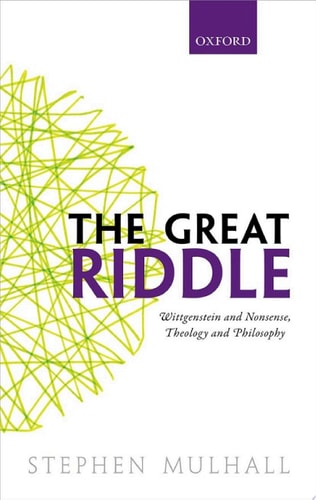
The Great Riddle: Wittgenstein and Nonsense, Theology and Philosophy
0
0
As an Amazon Associate and affiliate partner, Menrva Books earns from qualifying purchases. Learn more
Author Description
Can we talk meaningfully about God? The theological movement known as Grammatical Thomism affirms that religious language is nonsensical, because the reality of God is beyond our capacity for expression. Stephen Mulhall critically evaluates the claims of this movement (as exemplified in the work of Herbert McCabe and David Burrell) to be a legitimate inheritor of Wittgenstein's philosophical methods as well as Aquinas's theological project. The major obstacle to this claim is that Grammatical Thomism makes the nonsensicality of religious language when applied to God a touchstone of Thomist insight, whereas 'nonsense' is standardly taken to be solely a term of criticism in Wittgenstein's work. Mulhall argues that, if Wittgenstein is read in the terms provided by the work of Cora Diamond and Stanley Cavell, then a place can be found in both his early work and his later writings for a more positive role to be assigned to nonsensical utterances--one which depends on exploiting an analogy between religious language and riddles. And once this alignment between Wittgenstein and Aquinas is established, it also allows us to see various ways in which his later work has a perfectionist dimension--in that it overlaps with the concerns of moral perfectionism, and in that it attributes great philosophical significance to what theology and philosophy have traditionally called 'perfections' and 'transcendentals', particularly concepts such as Being, Truth, and Unity or Oneness. This results in a radical reconception of the role of analogous usage in language, and so in the relation between philosophy and theology.
Menrva's Summary
THE THESIS
Can the concept of 'nonsense' in Wittgenstein's philosophy be reconciled with the theological claims of Grammatical Thomism regarding religious language? Stephen Mulhall, a professor of philosophy, examines the intersection of Ludwig Wittgenstein's linguistic methods and the theological tradition of Thomas Aquinas. He challenges the assertion that religious language is inherently nonsensical by proposing a new reading of Wittgenstein that incorporates the perspectives of Cora Diamond and Stanley Cavell, ultimately arguing for a positive role for nonsensical utterances through the analogy of the riddle.
THE SCOPE MAP
What You Will Find
- A critical analysis of Grammatical Thomism as represented by Herbert McCabe and David Burrell.
- A re-evaluation of Wittgenstein's early and later works through the lens of moral perfectionism.
- An exploration of the relationship between philosophical concepts of 'perfections' and 'transcendentals' such as Being, Truth, and Unity.
Scope Limits
- The text does not provide a comprehensive history of Thomist theology.
- The analysis does not attempt to resolve all debates within contemporary analytic philosophy of religion.
THE AUTHORITY PERSPECTIVE
Scholars recognize this work as a sophisticated contribution to the dialogue between analytic philosophy and systematic theology. Readers frequently note the high level of academic density and the requirement for prior familiarity with both Wittgensteinian and Thomistic terminology.
Page Count:
146
Publication Date:
2015-01-01
Publisher:
OUP Oxford
ISBN-10:
0191071625
ISBN-13:
9780191071621
Philosophy
Wittgenstein
Aquinas
Religious Language
Metaphysics
History & Surveys
Theology
Community Tags
Similar Books