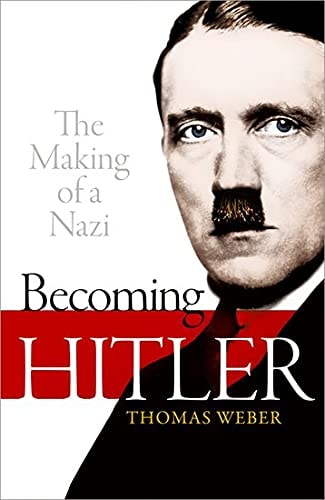
Becoming Hitler: The Making of a Nazi
0
0
As an Amazon Associate and affiliate partner, Menrva Books earns from qualifying purchases. Learn more
Author Description
The fateful story of Adolf Hitler's transformation from awkward, feckless loner to lethal, charismatic demagogue.The story of the making of Adolf Hitler that we are all familiar with is the one Hitler himself wove in his 1924 trial, and then expanded upon in Mein Kampf. It tells of his rapid emergence as National Socialist leader in 1919, and of how he successfully rallied most of Munich and the majority of Bavaria's establishment to support the famous beer-hall putsch of 1923. It is an account which has largely been taken at face value for over ninety years. Yet, on closer examination, Hitler's account of his experiences in the years immediately following the First World War turns out to be every bit as unreliable as his account of his experiences as a soldier during the war itself.In Becoming Hitler, Thomas Weber continues from where he left off in his previous book, Hitler's First War, stripping away the layers of myth and fabrication in Hitler's own tale to tell the real story of Hitler's politicization and radicalization in post-First World War Munich. It is the gripping account of how an awkward and unemployed loner with virtually no recognizable leadership qualities and fluctuating political ideas turned into the charismatic, self-assured, virulently anti-Semitic leader with an all-or-nothing approach to politics with whom the world was soon to become tragically familiar. As Weber clearly shows, far from the picture of a fully-formed political leader which Hitler wanted to portray in Mein Kampf, his ideas and priorities were still very uncertain and largely undefined in early 1919 ― and they continued to shift until 1923.It was the failed Ludendorff putsch of November 1923 - and the subsequent Ludendorff trial ― which was to prove the making of Hitler. And he was not slow to spot the opportunity that it offered. As the movers and shakers of Munich's political scene tried to blame everything on him in the course of the trial, Hitler was presented with a golden opportunity to place himself at the centre of attention, turning what had been the 'Ludendorff trial' into the 'Hitler trial'. Henceforth, he would no longer be merely a local Bavarian political leader. From now on, he would present himself as a potential 'national saviour'. In the months after the trial, Hitler cemented this myth by writing Mein Kampf from his comfortable prison cell. His years of metamorphosis were now behind him. His years as Führer were soon to come.
Menrva's Summary
THE THESIS
This book investigates the historical inaccuracies surrounding Adolf Hitler's political radicalization in the years following the First World War. Thomas Weber, a professor of history and international affairs, utilizes archival evidence and primary source analysis to dismantle the self-serving narrative Hitler constructed in his trial and subsequent writings. By examining the period between 1919 and 1923, Weber argues that Hitler was not a fully formed leader, but rather an unstable, shifting figure who only solidified his extremist ideology through the specific political failures of the 1923 putsch.
THE SCOPE MAP
What You Will Find
- Detailed analysis of the post-WWI political climate in Munich and Bavaria.
- Examination of the discrepancies between Hitler's personal accounts and historical records.
- Investigation into the influence of the 1923 Ludendorff trial on Hitler's public persona.
- A chronological study of Hitler's ideological evolution from 1919 to 1923.
THE AUTHORITY PERSPECTIVE
Historians and scholars recognize this work as a significant contribution to the study of the Third Reich, specifically for its rigorous debunking of long-standing myths. Readers frequently note the academic density of the prose and the author's meticulous attention to archival detail.
Page Count:
448
Publication Date:
2021-10-28
Publisher:
OUP Oxford
ISBN-10:
0199664633
ISBN-13:
9780199664634
Biography
History
Politics
Educational Resources
World War
World politics
European History
Europe
Community Tags
Other Editions(2)
Similar Books






Reader Comments
Share Your Thoughts
No comments yet. Be the first to share your thoughts!