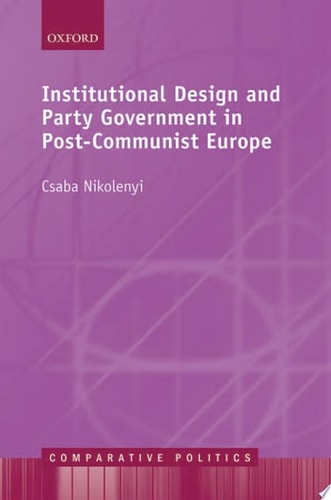
Institutional Design and Party Government in Post-Communist Europe
0
0
As an Amazon Associate and affiliate partner, Menrva Books earns from qualifying purchases. Learn more
Author Description
This books examines the institutional foundations of coalition government in the ten post-communist democracies of Eastern and Central Europe for the 1990-2010 period: Bulgaria, the Czech Republic, Estonia, Hungary, Latvia, Lithuania, Poland, Romania, Slovakia, and Slovenia. Its central argument is that differences in the arrangement of political institutions systematically explain variations in patterns of multi-party government across these states. The book starts with the premise that electoral systems and constitutional provisions about the powers, the structure, and the relationship between parliament and the presidency determine the degree to which political power is dispersed or concentrated in the political system. On the basis of these institutional features, three groups of states are distinguished with regard to their degree of power concentration; the substantive chapters of the book demonstrate how these institutional combinations and differences shape three specific facets of party government which capture the main stages of the lifecycle of coalitions governments: the formation of electoral coalitions, government formation and government duration. Specifically, three comparative chapters assess the impact of institutional power concentration on the size of electoral coalitions; the likelihood that political parties form a minority government; and the number of days that a government lasts in office. The main finding of the book is that power concentration matters: political parties in those democracies where institutions are designed to concentrate political power tend to form large electoral coalitions, they tend to form majority rather than undersized governments, and they build more durable cabinets. In addition, the book contains a detailed case study of government formation in Hungary and a previously unstudied comparison of indirect presidential elections in four states: the Czech Republic, Estonia, Hungary and Latvia.
Menrva's Summary
THE THESIS
This book investigates how institutional design influences the stability and formation of coalition governments within post-communist democracies. Author Csaba Nikolenyi, a specialist in comparative politics, utilizes a comparative framework to analyze political data from ten Eastern and Central European nations between 1990 and 2010. He argues that constitutional provisions and electoral systems create varying degrees of power concentration, which directly dictate the lifecycle of multi-party governments. By examining these structural variables, the text provides a systematic explanation for why some nations experience more durable cabinets than others.
THE SCOPE MAP
What You Will Find
- Comparative analysis of ten post-communist states including Poland, Hungary, and the Czech Republic.
- Quantitative assessment of electoral coalition size and government duration.
- Examination of the relationship between parliamentary structures and presidential powers.
- Detailed case studies on government formation in Hungary and indirect presidential elections.
THE AUTHORITY PERSPECTIVE
Experts recognize this work as a rigorous contribution to the study of parliamentary systems in transitional democracies. Scholars frequently note the empirical density of the research, which serves as a foundational text for understanding institutional effects on executive stability.
Page Count:
240
Publication Date:
2014-12-16
Publisher:
Oxford University Press
ISBN-10:
0199675309
ISBN-13:
9780199675302
Post-communism
Government
European History
Europe central
Europe Eastern
Comparative Politics
Community Tags
Other Editions(2)
Similar Books







Reader Comments
Share Your Thoughts
No comments yet. Be the first to share your thoughts!