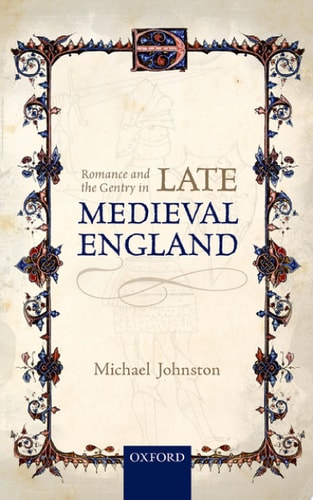
Romance and the Gentry in Late Medieval England
0
0
As an Amazon Associate and affiliate partner, Menrva Books earns from qualifying purchases. Learn more
Author Description
Romance and the Gentry in Late Medieval England offers a new history of Middle English romance, the most popular genre of secular literature in the English Middle Ages. Michael Johnston argues that many of the romances composed in England from 1350-1500 arose in response to the specific socio-economic concerns of the gentry, the class of English landowners who lacked titles of nobility and hence occupied the lower rungs of the aristocracy. The end of the fourteenth century in England witnessed power devolving to the gentry, who became one of the dominant political and economic forces in provincial society. As Johnston demonstrates, this social change also affected England's literary culture, particularly the composition and readership of romance. Romance and the Gentry in Late Medieval England identifies a series of new topoi in Middle English that responded to the gentry's economic interests. But beyond social history and literary criticism, it also speaks to manuscript studies, showing that most of the codices of the "gentry romances" were produced by those in the immediate employ of the gentry. By bringing together literary criticism and manuscript studies, this book speaks to two scholarly communities often insulated from one another: it invites manuscript scholars to pay closer attention to the cultural resonances of the texts within medieval codices; simultaneously, it encourages literary scholars to be more attentive to the cultural resonances of surviving medieval codices.
Menrva's Summary
THE THESIS
This book investigates how the socio-economic status and political rise of the English gentry between 1350 and 1500 directly influenced the composition and production of Middle English romance literature. Michael V. Johnston, a scholar of medieval literature and codicology, utilizes a combination of literary analysis and manuscript studies to argue that these texts were not merely aesthetic works but functional responses to the specific economic interests of the landowning class. By examining the intersection of social history and material culture, the author demonstrates how the gentry shaped the literary landscape of late medieval England. The work provides a framework for understanding how power dynamics in provincial society were reflected in the production of codices.
THE SCOPE MAP
What You Will Find
- Analysis of Middle English romance literature produced between 1350 and 1500.
- Examination of the socio-economic concerns and political influence of the English gentry.
- Investigation into the production and ownership of medieval manuscripts and codices.
- A methodological synthesis connecting literary criticism with physical manuscript studies.
THE AUTHORITY PERSPECTIVE
Scholars frequently note the book's success in bridging the gap between literary analysis and the material study of medieval manuscripts. Experts highlight this work as a significant contribution to understanding the cultural and economic motivations behind the popularity of romance literature in the late Middle Ages.
Page Count:
320
Publication Date:
2014-08-12
Publisher:
Oxford University Press
ISBN-10:
0199679789
ISBN-13:
9780199679782
History
British History
English & College Success
Romances
English
Literary Criticism
English literature
Cultural History
Gentry
Community Tags
Similar Books